We've seen real estate agencies, electricians, HVAC businesses and manufacturers bring print and digital activity together. The details change with the business. The starting point stays the same: decide where you want more work, give each channel a job, and make it easy to see what happened after someone responded.
This guide draws on those client experiences, our distribution and call tracking work, and Australian research. You'll learn how to choose an area, coordinate the campaign and build a simple record for the next decision.
How real estate agents connect advertising with door knocking
For a real estate agency, the aim is to become familiar in the suburbs where it wants more property conversations. A printed piece, a local ad and a visit from an agent can each help introduce the same proposition.
The agents we work with choose their target suburbs and align their Google advertising with a print campaign in those areas. In the sequence we've seen, digital activity starts first, followed about a week later by flyers or magnets. The agents then plan their door knocking around the delivery.
Our part is to help organise the distribution and confirm when the agreed area is finished. That gives the agents a practical cue: they can follow through within the next day or two, while the printed campaign is still recent.
Here's the sequence a business can take from it:
- Choose the area: agree the suburbs and the type of property conversation you want.
- Introduce the message: run local advertising with a clear reason to get in touch.
- Deliver the printed piece: keep the message recognisable across the ad and the flyer or magnet.
- Confirm completion: use the distribution update to organise the next step.
- Follow up locally: have a brief, respectful conversation and record any agreed next step.
The lesson is the handover between activities. When the agent knows the delivery is complete, door knocking can become a planned part of the campaign. The team has a reason to be in that area and a timely starting point for the conversation.
- Choose the streetsAgree the area the agent will work.
- Align ads and printUse the same local message in that area.
- Confirm deliveryUse the distribution report to time the visit.
- Follow up locallyOur real estate clients visit within a day or two.
Give each channel a different job
A person searching for an electrician today is in a different situation from someone who keeps a magnet for a future job. The campaign should make sense in both situations.
- Google Search: reach people actively looking for the service.
- Meta: introduce the business or reinforce a relevant local message.
- Flyers and magnets: put the business's offer and contact details into the area physically.
- Human follow-up: answer questions and agree the next step.
- Call and form tracking: show which response route brought the enquiry in.
Keep the offer consistent, but write for the channel. A search ad needs to answer an immediate need. A flyer has room to explain the service. A conversation gives someone the chance to ask a question.
How the approach changes for electricians, HVAC and manufacturers
We've also seen electrical, HVAC and manufacturing businesses combine print with digital advertising. Their useful target areas and follow-up needs differ from those of a real estate agency.
For an electrician or HVAC business, start with suburbs the team can reach efficiently and the work it wants more of. A campaign might focus on a particular service, a seasonal need or maintenance. Search advertising can meet immediate demand, while a flyer or magnet gives residents something to keep for later.
For a manufacturer, the area may be an industrial precinct or business park. Business-to-business distribution puts the offer into that commercial area. Search ads can reach people looking for the capability, and relevant email or SMS can support follow-up where the relationship and permission allow it. The B2B campaign guide explains how to give those contacts different jobs.
For your own business, ask:
- Which suburbs or business areas can we serve well?
- What kind of enquiry would we like more of?
- What should someone do after seeing the message?
- Who will answer and follow up when they do?
Those answers make the campaign brief more useful than a list of suburbs and a print quantity.
Choose the zone before buying the media
We use zone to mean the practical area a campaign focuses on. It could be a suburb, neighbouring suburbs, a service area or an industrial precinct.
Start with your service coverage, existing customer patterns, local knowledge and capacity. Then use area data to explore where the offer may be relevant.
For one aged-care and NDIS provider, we used public demographic, geographic and sector information to give the business clearer indicators of which areas deserved attention. That area plan could inform both the distribution and its Google Ads targeting.
Australian sources can help answer different planning questions:
- ABS QuickStats: what are the area's age, household, language and housing characteristics?
- ABS SEIFA: how do areas compare on measures of relative socio-economic advantage and disadvantage?
- NDIS and AIHW resources: what geographic and service information is relevant to the provider's planning?
This is area-level planning: it describes populations and places, not an individual household's needs or eligibility.
Use that information to make a shortlist, then check it against where you can deliver the service. Agree the same area names with the people organising print, digital advertising and enquiry handling so their records can be compared later.
What Australian research adds
IAB Australia's multichannel research synthesis brings together contributions from measurement specialists including Kantar, Nielsen, Mutinex and Neuro-Insight. It describes how channels can contribute together to brand and business outcomes, with creative execution, context, reach and measurement all playing a part.
A useful Australian example comes from Australia Post's Nextdoor case study. More than 500,000 neighbour-to-neighbour invitations were mailed over 12 months, with one in five recipient households signing up online. The case shows how a physical message can lead to a recorded online response.
Australian campaign evidence · Australia Post
Nextdoor: a local letter with a clear online action- Local trigger
- An existing member invited neighbours to join.
- Physical message
- A printed invitation gave the household a reason to visit online.
- Recorded response
- Online sign-ups gave the campaign an observable next step.
For a local business, apply that thinking to the campaign brief: one audience, a recognisable message, a clear next step and a way to record the response.
How Gibson applies the method
Our distribution work brings together the area plan, the printed piece and delivery coordination. Call tracking adds a way to identify where phone enquiries came from. The business and its advertising team use the same area plan for digital activity and retain control of their ad budgets and settings.
Before launch, agree who owns each part:
- Area and message: the suburbs, customer type, service and offer.
- Distribution: the delivery area and completion update. Delivery reports and inspection photos are available on request.
- Digital activity: the location settings, dates and matching message.
- Response: the phone numbers, forms and person responsible for follow-up.
- Review: the enquiry and sales records that will inform the next campaign.
Read the Google Ads map alongside the distribution plan
The complete Google Ads location screen
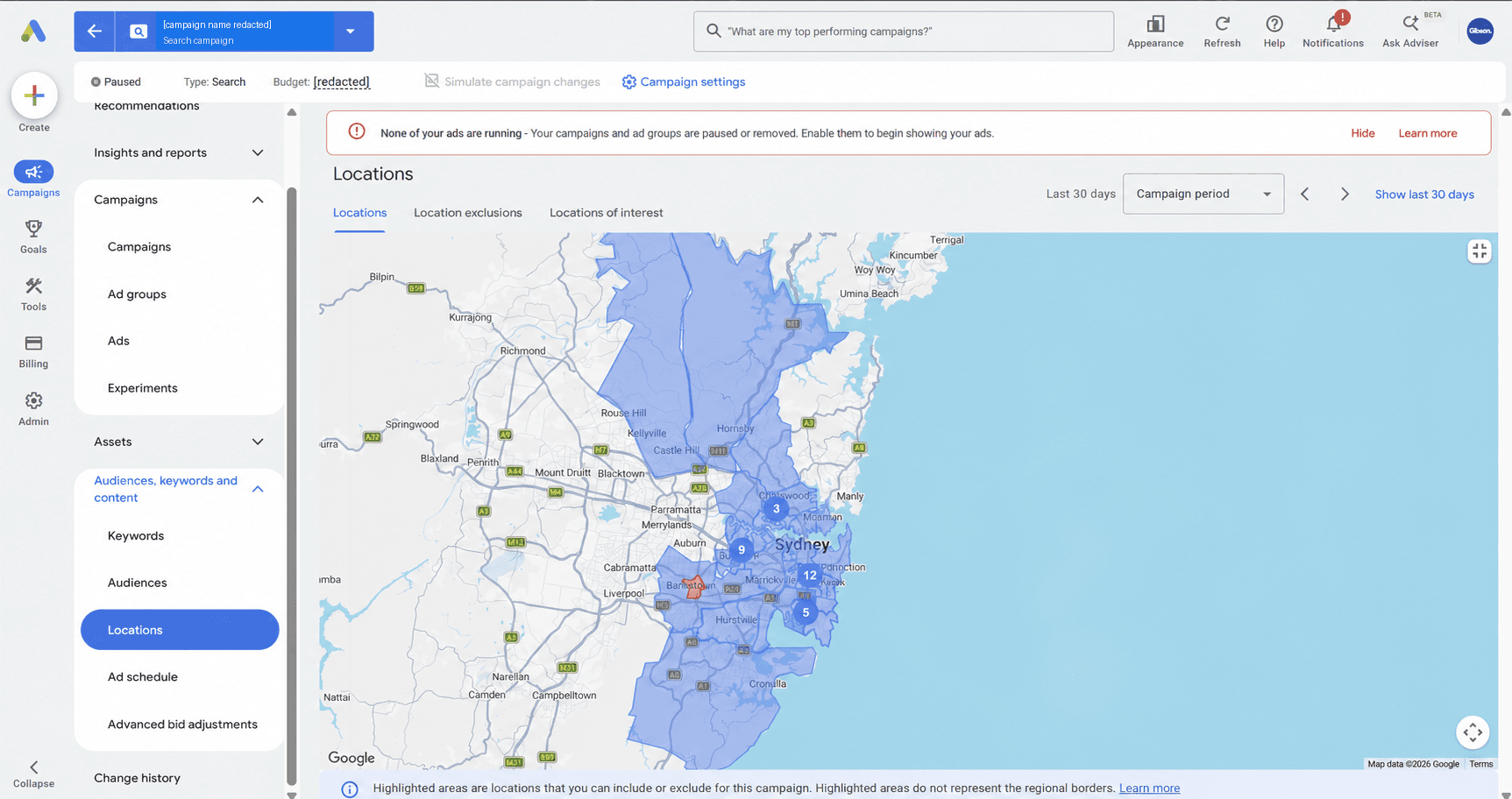
Start by comparing the shaded advertising area with the planned distribution suburbs. In this example, the advertising covers a broader Sydney area and the planned North Shore flyer run sits within it.
For your campaign, check that the suburbs you want are included, any exclusions are intentional, and the team can serve the area. Google's location targeting uses signals rather than exact household boundaries, so use the map to align the geography and the enquiry records to review the response.
Agree the tracking before booking the media
Decide how the flyer response will be recognised and how Google Ads calls and forms will retain their source. Use the same suburb names in both sets of records. Agree who will answer and follow up.
That is enough to put the measurement requirements into your area brief. The enquiry measurement guide covers the tracking setup, record fields and later review in detail.
After the campaign, bring the findings back to the area plan: which suburbs produced suitable enquiries, where the team could serve the work and what needs to change before the next run.
Takeaway: the one-page zone plan
Before the next campaign, put the area, customer type, offer, channel roles, dates, tracking and follow-up owner on one page. Agree what a useful enquiry looks like and how the team will record the outcome.
That gives everyone the same brief, from the person preparing the flyer to the person answering the phone.
- Area
- Where can we serve customers?
- Customer need
- What problem are we solving?
- Local offer
- Why respond to this message?
- Channel jobs
- What will ads, print and follow-up each do?
- Response routes
- How will calls and forms be identified?
- Follow-up owner
- Who takes the next step?