What you need to know
- List the source, enquiry and outcome records before proposing a connection.
- A traffic source is not the same as a named customer or a paid job.
- Match records using available identifiers, dates and permissions; do not guess missing links.
- The result should be a practical action plan with clear limits and owners.
What can be connected, and what cannot?
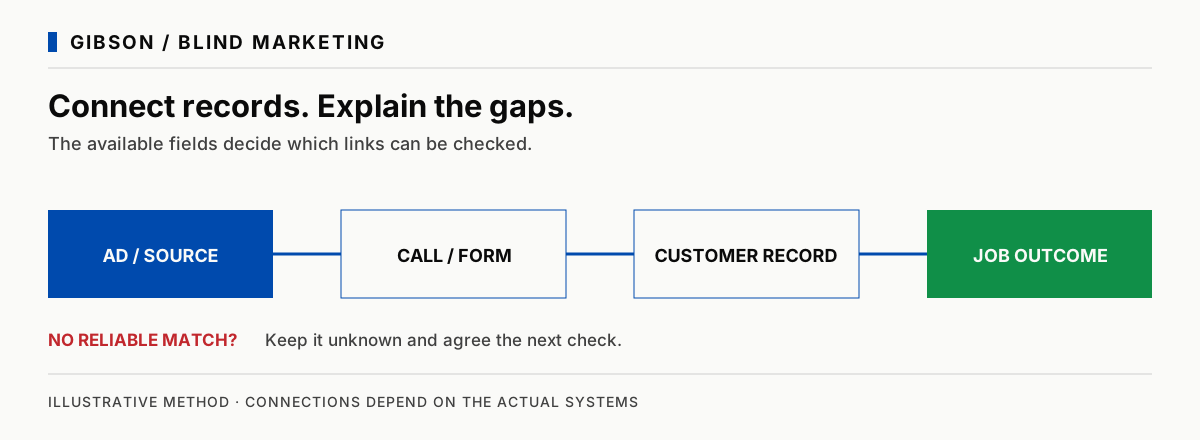
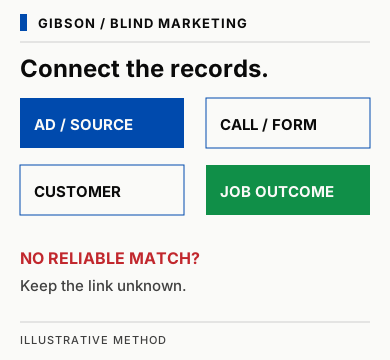
A marketing report can show a campaign, source or visit. A call log or form can show a contact attempt. A customer system can show the person, request, quote or opportunity. Job and payment systems can show an accepted and paid outcome. These records can sometimes be linked, but none of them alone proves the whole journey.
The first step is an inventory: which systems are in use, who can access them, what identifiers and timestamps they keep, and whether the business has permission to use the data for this purpose. Where a source is lost before the enquiry reaches the customer record, label it unknown. A tidy dashboard built on guessed links is less useful than an honest gap.
| Record | Question it can answer | Common limit to check |
|---|---|---|
| Advertising or site analytics | Which source or campaign led to an observable visit? | The visit may not identify a customer. |
| Call or form | What contact attempt arrived and when? | The same person may use more than one channel. |
| CRM or booking record | What did the person ask for and who owns it? | Source and outcome fields may be missing. |
| Job or payment record | Was work accepted and paid? | A reliable link to the original enquiry may be absent. |
How do you make a reliable match?
Use identifiers the systems actually provide: a form submission ID, a call record ID, a permitted customer reference, a booking ID or a deal reference. Confirm how dates and time zones line up. Review duplicates before counting a call and a form as two different opportunities. Keep the raw event and the matched business record distinct so the link can be checked later.
Google Analytics has separate source dimensions for events, sessions and first users. They answer different attribution questions. Choose the dimension that matches the report, then compare it with the enquiry record. Zoho CRM can map lead fields into contact, account and deal records during conversion, but the actual mapping must be checked. Neither platform guarantees a paid job is linked without the relevant business records.
- Define the source field and the event that created the enquiry.
- Choose a stable identifier or documented matching rule.
- Check duplicate contacts and any manual changes.
- Mark unmatched records with the reason, rather than assigning a source.
What should the first review produce?
The first review should produce a short map of the records that can be trusted, the links that can be tested and the gaps that remain. It should state which enquiries became suitable opportunities, accepted jobs and paid outcomes only where those states are supported. It should also show where the process breaks: missing source tags, unanswered contacts, unowned quotes or absent outcome updates.
Then agree an action, owner and way to check it. This might be a field-mapping correction, a callback process, a clearer job status or a supported integration. The business decides what is worth changing. Gibson does not need credentials or customer exports in a public enquiry form; access and handling are agreed separately if the work proceeds.
Where does Gibson's role begin and end?
Gibson connects available advertising, enquiry and sales records, identifies gaps and agrees an action plan with your business. The exact method depends on the tools, fields, permissions and scope confirmed during review. A supported connection may be appropriate; a manual comparison may be the honest starting point. We do not promise that every historical enquiry can be attributed.
Your existing team retains control of advertising and budgets. The aim is to give them more useful information about genuine enquiries and downstream work, while giving the business a clearer next step.
Frequently asked questions
Do I need to replace my CRM?
No decision to replace a system follows from the article. Start by checking what your current tools record and whether their fields can support the question you need answered.
Can every ad click be tied to a paid job?
No. Identifiers, consent, source visibility and record quality differ. Show which links are supported and keep the rest unknown.
Should I send customer records through the website form?
No. The initial enquiry asks about your systems and visibility gap. Any later access or data handling must be agreed for the work itself.
Does Gibson manage the ads?
No. Gibson helps connect the available records and agree an action plan. Your business and marketing team retain control of ads and budgets.
Sources and evidence
- Google Analytics: scopes of traffic-source dimensions: Explains why event, session and first-user source fields answer different attribution questions.
- Zoho CRM: converting leads: Describes optional deal creation and field mapping during lead conversion.