What you need to know
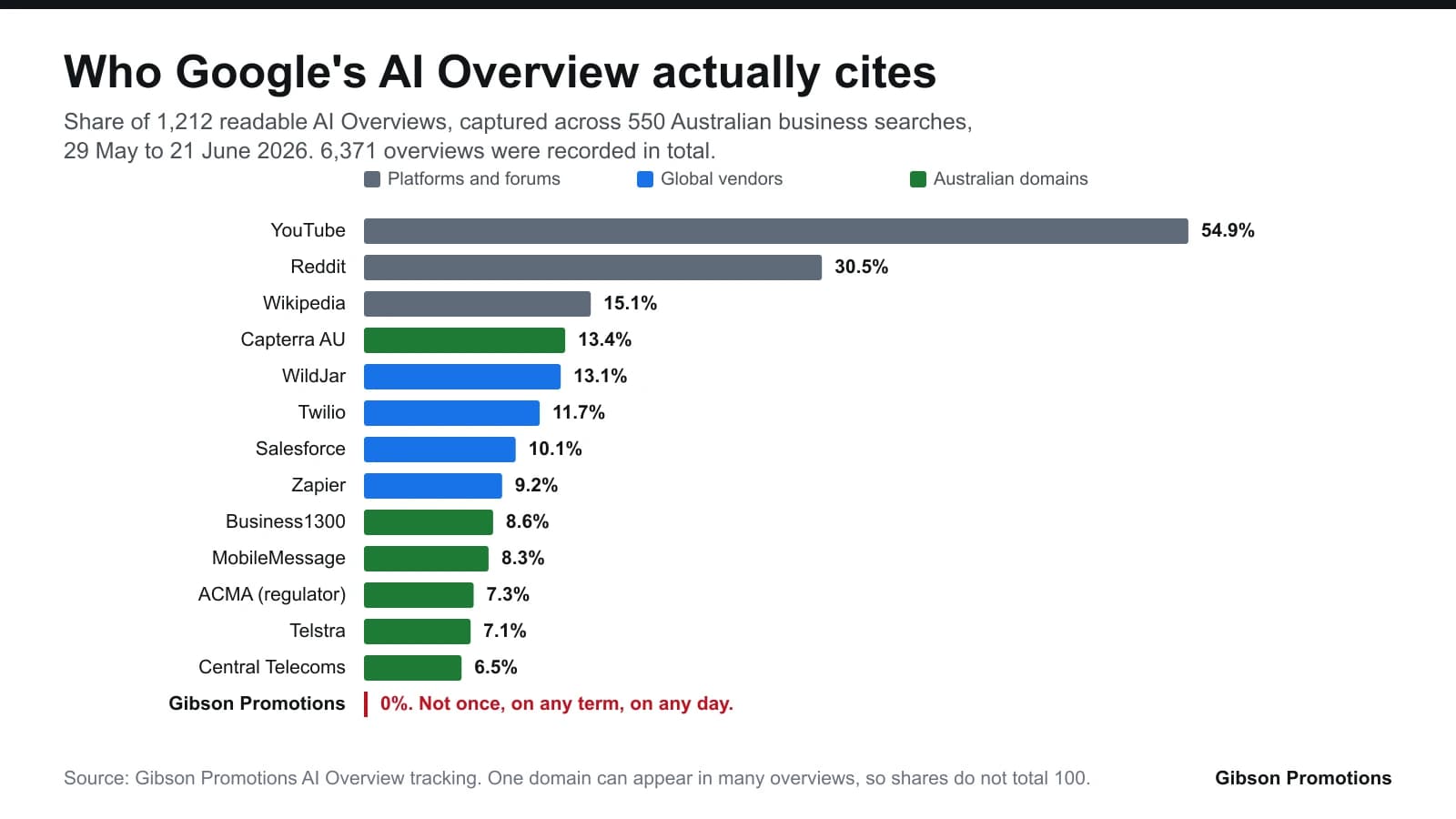
- YouTube appeared in 54.9 percent of the AI Overviews we could read. It is cited more often than any website, in a dataset made entirely of business software and service searches.
- Reddit appeared in 30.5 percent. Community discussion is cited more often than any supplier's own website.
- Australian specialist suppliers do get cited, so this is winnable. Six Australian domains each appeared in more than 5 percent of overviews.
- On compliance questions you are competing with the regulator itself. ACMA appeared in 7.3 percent of the overviews we read.
- Google's AI Overview and ChatGPT are two different problems with two different winners. In the measured research window, Gibson recorded zero citations across 6,371 Google AI Overviews. A separate ChatGPT-referred visit reached a genuine quote enquiry.
What we did, and why we bothered
Every business owner has now had the same uncomfortable thought. If customers ask an AI instead of scrolling Google, what happens to the business that spent years earning position three?
There is no shortage of opinion about this. There is very little Australian measurement. Most of what circulates is either American, or a vendor explaining why the answer happens to be their product.
So we measured it. We took 550 search terms that Australian businesses actually type when they are looking for phone systems, call tracking, SMS marketing, distribution and business automation. We ran every one of them through an Australian desktop search, every day, for three weeks. We captured the AI Overview when one appeared, and we recorded every source it cited.
That produced 8,338 individual search captures between 29 May and 18 June 2026. An AI Overview appeared in 6,371 of them, which is 76.4 percent. Of our 550 terms, 485 triggered an AI Overview at least once. Put plainly: in this category, the AI answer is now the normal result, not the exception.
Across those overviews Google cited 1,216 distinct domains, at an average of 8.6 sources per answer.
Finding 1: the most cited source is not a website
YouTube appeared in 54.9 percent of the AI Overviews we could read. It showed up for 61 of our search terms, more than any other domain by a wide margin.
Read that again in context. These are not searches about entertainment. These are searches like call tracking software, dynamic number insertion, and SMS compliance. Dry, commercial, business to business terms. And more than half the time, Google's AI answer leans on a video.
There is a reasonable explanation. A video demonstrating how something works answers a how question more completely than a page describing it, and Google owns YouTube and can parse its transcripts with total confidence. Whatever the cause, the practical consequence is the same. If you have written forty articles and filmed nothing, you have skipped the single most cited source type in your own category.
This is the most actionable finding in the entire dataset, and it is the one almost no Australian service business is acting on.
Finding 2: Reddit beats every supplier's own website
Reddit appeared in 30.5 percent of readable overviews, across 48 of our 550 terms. Wikipedia came third at 15.1 percent.
No supplier website in our dataset came close to Reddit. That is worth sitting with. When someone asks Google which call tracking system to use, the AI is more likely to quote a forum thread of people arguing about it than any vendor explaining their own product.
The lesson is not to spam Reddit. That is transparently obvious to both moderators and models, and it backfires. The lesson is that unfiltered discussion carries a credibility that marketing copy cannot buy. If your product is genuinely being discussed by real users in real communities, you are in the citation pool. If it is only ever described by you, you are not.
It also explains something that frustrates a lot of business owners: you can have the most thorough page on the internet about your service and still be invisible in the AI answer, because the model is not looking for the best sales page. It is looking for a source it can stand behind.
Finding 3: where suppliers do win, and it is winnable
It would be easy to conclude that only giants and forums get cited. The data says otherwise.
Several Australian specialist suppliers earned meaningful citation share in our dataset. One call tracking vendor appeared in 13.1 percent of readable overviews across 14 terms. An Australian 1300 number provider reached 8.6 percent. An Australian SMS provider reached 8.3 percent. Several smaller Australian telecoms and messaging specialists each cleared 4 to 6 percent.
None of these are household names. None of them outrank Telstra on brand. They earned citations by being narrowly, specifically, verifiably useful about an Australian problem.
That is the encouraging half of this research. Citation share is not purely a function of size. It is a function of being the clearest available answer to a specific question in a specific market.
The discouraging half: on generic best of and top ten searches, the review aggregators dominate. One comparison site appeared in 13.4 percent of readable overviews. If your content plan is a list of the best tools in your category, you are entering the one contest where the incumbent is strongest and your authority counts for least.
Finding 4: on compliance questions you are competing with the regulator
The Australian Communications and Media Authority appeared in 7.3 percent of readable overviews, across 11 of our terms, clustered almost entirely on compliance questions. Is this legal, what consent do I need, what are the rules.
This is a genuinely useful thing to know before you commission content. When a customer asks whether SMS marketing is legal, the model has access to the actual regulator. You will not out authority the body that writes the rule.
That does not mean compliance content is a dead end. It means your angle has to be different from the regulator's. ACMA publishes the law. It does not publish what the law means for a plumber with 2,000 old customer numbers and no idea whether he can text them. The regulator states the rule; you translate the rule into a decision.
Practical interpretation, worked examples and plain English are the gap. Restating the legislation is not, because the source of the legislation is already in the room.
The limitation you should know about before quoting us
Honest research states what it cannot see, so here is ours.
Of the 6,371 captures where an AI Overview appeared, only 1,212 returned source references we could read. In the remaining 5,159, the overview was present but its citations were loaded separately by the browser and were not in the response we captured.
So every percentage in this article is a share of the 1,212 readable overviews, not of all 6,371. We have said so at every point rather than quoting the bigger, more flattering denominator.
This matters for how much weight you put on the numbers. The direction of the findings is strong, consistent across 21 days and 485 distinct search terms. The precise decimal places are not gospel. Treat YouTube at 54.9 percent as clear evidence that video dominates this category, and not as a claim that the true figure is exactly 54.9.
We will re-run this quarterly. If the ratios move, we will publish that too, including if it makes earlier conclusions look wrong.
What did the separate AI-referral record show?
We can trace an AI-referred visit from a cited article to a genuine quote enquiry, which is a claim worth being precise about, so here is the whole record.
On 6 July 2026 an enquiry landed in our CRM. Its first touch was recorded as chatgpt.com, its landing page was /blog/letterbox-distribution-cost-sydney carrying ChatGPT's own utm_source tag, and the visitor then moved to our quote page and asked for a price on letterbox distribution. ChatGPT quoted the article, a person read it, and that person became an enquiry. Microsoft Copilot has cited the same article.
That is the part most AI search reporting cannot do. A citation counter tells you that you appeared. An attribution record shows what happened next. This record supports enquiry attribution, not sale value or a universal conversion claim.
Now the uncomfortable half of the same dataset. Across all 6,371 Google AI Overview captures, running to 21 June, our own site was cited zero times. Not once, on any search term, on any day.
At that point, the site already had structured data, long-form content, question-based headings and technical controls. None of those elements produced a Gibson citation in this measured window.
A later depersonalised Google result on 6 August showed Gibson as an AI Overview source and the first standard organic listing for one redacted priority query. The dated evidence, limitation and operating method are documented in How Gibson Built an AI-Enabled Website Operating System.
The article that did get quoted was none of those things. It was not a service page and it was not optimised for anything in particular. It published a real price range for a real market, which nobody else had bothered to do.
So the conclusion from our own data is this. Being cited in Google's AI Overview and being quoted by ChatGPT are two different problems with two different winners. Google's overview, in our category, leans on video, forums and established authority. ChatGPT and Copilot were happier to quote a specific, costed, useful answer from a small business. If you are treating AI search as one channel, you are optimising for an average that does not exist.
The article in question is still live if you want to see what a citable page actually looks like: what letterbox distribution costs in Sydney. It is not clever. It is a price range, a set of assumptions, and the reasons the number moves.
What this changes about the content you make
Six things we would now tell any Australian service business, based on this data rather than on general advice.
Film the explanation you already wrote. Video is the most cited source type in this entire dataset and almost none of your competitors are producing it. A three minute screen recording answering one specific question is a genuine asset here.
Publish the number nobody else will. Prices, response rates, real benchmarks. One cited cost article was the landing page for a genuine quote enquiry. Specific, sourced information gives answer engines something concrete to assess.
Answer one question per page. Overviews cite pages that resolve a question completely, not pages that cover a topic broadly. A page trying to answer three questions tends to be cited for none.
Say Australia, and say the year, in the body text. Jurisdiction and recency are the two things a global source cannot fake, and they are exactly why a local page gets pulled into a local answer.
Stop writing best of listicles. The aggregators own that space in the data, and you are handing them the citation.
Be discussed, not just described. If real users are not talking about you anywhere you do not control, you are absent from the second most cited source in your category.
If you want a read on where your own pages sit before you rewrite anything, our AEO checker scores a URL on the structural things AI engines look for: answerable headings, extractable facts, and whether a machine can tell what the page is claiming.
To work through one customer question yourself, use the free Question-to-Enquiry AI Search Framework.
How we measured this, so you can measure yours
The method matters more than our particular numbers, because you can run this on your own category.
First, define the search terms honestly. Ours are the 550 terms our customers actually use, not the terms we wish they used. Vanity terms produce vanity findings.
Second, capture daily, not once. AI Overviews are volatile. A single snapshot tells you almost nothing. Ours moved noticeably across 21 days, and any conclusion drawn from one day's capture would have been wrong.
Third, set the location and device deliberately. We captured Australian desktop results. An overview served to a Sydney customer is not the overview served to a US one, and mixing them quietly corrupts the result.
Fourth, store every capture, not just the summary. We keep one row per search term per day, including which sources were cited and which of our pages was named. That last field is the one we had missing for months. Without it, a business can miss the connection between a cited article and a later observable action.
Fifth, connect the citation to the next observable record. We record first touch and landing page against every enquiry, so when a lead arrives we can name the observed route. In this case, a cited cost article was the landing page for one genuine quote enquiry. That supports enquiry attribution, not sale value.
None of this requires an enterprise budget. It requires deciding what to record before you need it, which is the part almost everyone skips.
The companion piece to this one, on phone click tracking counting bots, works through the same discipline applied to a different dataset, including the part where our own numbers turned out to be wrong.
The uncomfortable summary
In the category we measured, three quarters of Australian business searches now return an AI answer. That answer cites a video more than half the time, a forum a third of the time, and a supplier's own website considerably less often than either.
Small Australian suppliers do get cited, consistently, when they publish something specific and verifiable about an Australian problem. Nobody gets cited for describing themselves well.
The strategies that earn a citation in Google's overview are not the same as the ones that get you quoted by ChatGPT. Gibson recorded zero Google citations in the measured May to June window, one ChatGPT-referred quote enquiry in July and one dated Google AI Overview citation for a redacted query in August.
If you take one thing from three weeks of data: publish the number nobody else will publish, and film the answer nobody else has filmed. Everything else in this article is detail.
Frequently asked questions
How many AI Overviews did you actually analyse?
We captured 8,338 Australian desktop searches across 550 business search terms between 29 May and 18 June 2026. An AI Overview appeared in 6,371 of those captures, which is 76.4 percent. Of those, 1,212 returned source references we could read and analyse. Every percentage in the article is a share of those 1,212 readable overviews, which we state throughout rather than quoting the larger number.
Why does YouTube get cited so often in business searches?
In our dataset YouTube appeared in 54.9 percent of readable AI Overviews across 61 search terms, more than any other domain. The likely reasons are that video answers how questions more completely than text, and that Google can parse YouTube transcripts with total confidence because it owns the platform. The practical consequence for an Australian business is that video is the most cited source type in the category and almost no local service businesses are producing it.
Does appearing in Google's AI Overview also mean ChatGPT will cite me?
No. In Gibson's 29 May to 18 June research window, Google recorded zero Gibson citations across 6,371 AI Overview captures. A separate ChatGPT-referred visit reached a genuine quote enquiry. A later 6 August Google result showed Gibson cited for one redacted query. These are different systems and dated observations, not permanent visibility claims.
Is it worth writing best of and top ten comparison articles?
Our data suggests not, for most suppliers. Review aggregators dominate that space: one comparison site appeared in 13.4 percent of readable overviews. Competing there means entering the one contest where the incumbent has the most authority and yours counts for least. Comparisons are still worth doing when the comparison itself is proprietary, for example a cost per lead comparison run on your own campaign data, because nobody else can produce that.
Can a small Australian business realistically get cited?
Yes. Several Australian specialist suppliers earned meaningful citation share in our dataset without being household names, including an Australian 1300 provider at 8.6 percent and an Australian SMS provider at 8.3 percent. They earned it by being narrowly and verifiably useful about a specific Australian problem, not by outranking large brands. Citation share follows clarity and specificity more than size.
How often will you update this research?
Quarterly. AI Overviews are volatile enough that a single snapshot is close to meaningless, which is why we captured daily across three weeks rather than once. When we re-run it we will publish the movement, including any result that makes a conclusion in this article look wrong.