What you need to know
- Start with a genuine customer question, not a list of keywords.
- Choose the content format that helps the customer make the next decision. Sometimes the correct answer is no new page.
- Give the AI only approved evidence and require it to identify missing proof before drafting.
- Use topic language naturally. Repeating a search phrase does not make an answer more useful.
- Connect the page to one observable next action, such as a tracked call, form or approved campaign response.
- The public starter works in the user's own AI account and does not require sending information to Gibson.
What is the Question-to-Enquiry AI Search Framework?
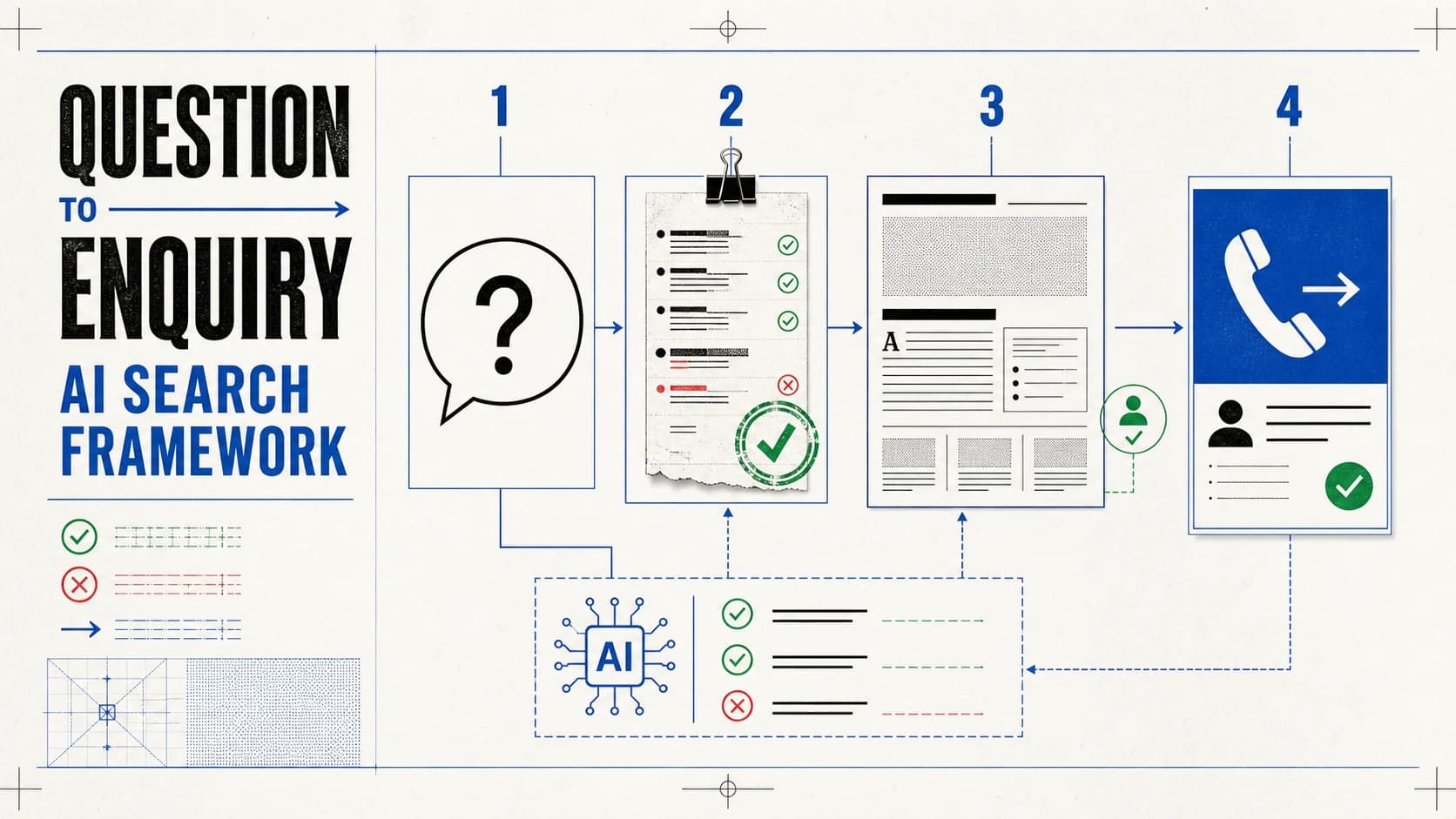
The Question-to-Enquiry AI Search Framework is a lightweight briefing method for turning one real customer question into useful, evidence-led content and a measurable next action.
It is designed for a business owner using ChatGPT, Claude, Gemini or another capable AI assistant. The business supplies the question, audience, approved evidence and measurement. The AI helps compare formats, structure the answer and identify gaps. A human remains responsible for accuracy and publication.
What should you collect before asking AI to draft?
Do not begin with a request to write an SEO article. Give the assistant enough operating context to decide whether content is justified.
- The exact customer question in the customer's language.
- The person who needs the answer and the decision they are making.
- The evidence the business is allowed to publish.
- The next action the business can genuinely observe and measure.
“If the evidence is missing, the AI should ask for it. It should not fill the gap with a confident paragraph.”
How do you stop AI from inventing proof?
Create an evidence register before writing. Record the proposed claim, supporting source, evidence date, permission and limitation. If a claim has no source, remove it or mark it as an open question.
Do not ask the AI to make the article stronger by adding statistics. Ask it to identify where a statistic would help and what source would be required.
| Field | What to record |
|---|---|
| Claim | The exact statement proposed for publication |
| Source | The original record, system, document or named authority |
| Date | When the evidence was captured or last confirmed |
| Permission | Whether public use is approved |
| Boundary | What the evidence does not establish |
Which content format should answer the question?
A keyword does not automatically deserve an article. Choose the smallest format that gives the customer a complete answer and supports the next decision.
| Customer need | Useful format | Measurement example |
|---|---|---|
| Understand a term or mechanism | Guide or service explainer | Qualified page path or assisted call |
| Compare two approaches | Comparison table or article | Selected service or review request |
| Complete a repeatable task | Checklist, template or tool | Completed download or tool result |
| Test a cost or volume assumption | Calculator | Saved result or follow-up request |
| Inspect a real implementation | Case study | Evidence-page engagement or relevant enquiry |
| Question already answered well | Improve the existing page | Change in qualified engagement |
What prompt can you copy into your own AI?
Copy the starter below into your own AI assistant, then answer each question with approved information only. After the six inputs, the AI must return the same eight output sections in order. Do not paste customer records, personal information, private contracts or unapproved results into a public AI tool.
The same starter is available as a plain-text download.
Copy into ChatGPT, Claude, Gemini or another AI assistant
You are helping me turn one real customer question into a useful, evidence-led content asset for an Australian business. Use Australian English. Write for the customer first. Search and AI extractability come second.

BEFORE DRAFTING
Ask me for these six inputs, one at a time. Do not draft until all six are answered.
1. The real customer question to answer.
2. The person who needs the answer and the decision they are making.
3. The business, service, location and named entities the answer needs to identify.
4. The approved evidence I can publish, including its source, date, permission and limitation.
5. Existing relevant pages I may link to. If there are none, record none.
6. The next action I can genuinely offer and the outcome I can measure.

If an answer is unclear, ask one follow-up question. Do not fill gaps yourself.

CONTENT DECISION
Choose the smallest useful format: improve an existing page, create a new page or article, comparison, checklist, calculator, video, or no new content. If no content is warranted, say so and explain why.

RETURN EXACTLY THIS OUTPUT STRUCTURE

1. CONTENT DECISION
State the recommended format, whether it is new or existing content, the intended reader, the decision it supports and why this is the smallest useful format.

2. EVIDENCE REGISTER
Create a table with these columns: Proposed claim | Supported? | Approved source | Evidence date | Permission or limitation. Mark unsupported claims as [EVIDENCE REQUIRED]. Do not draft them as facts.

3. DIRECT ANSWER
Write a self-contained answer of 40 to 70 words that a person or answer engine can understand without the rest of the page.

4. READER-FIRST STRUCTURE
Provide a proposed title or H1, question-based H2 and H3 headings in decision order, and note where a table, list, comparison or example would make the answer clearer.

5. DRAFT OR PRODUCTION BRIEF
For a page, article, comparison or checklist, produce a complete first draft using supported evidence only. For a calculator or video, produce a production brief or script. Lead each section with its answer, keep one main idea per paragraph and remove generic marketing filler.

6. FAQ AND LINK PLAN
Write 3 to 5 natural-language questions with direct answers. Suggest relevant internal links with a reason for each one, and list any authoritative external sources used. Do not invent a link or source.

7. NEXT ACTION AND MEASUREMENT
Recommend one useful call to action. State what should be recorded at the source, landing page, page action, enquiry and agreed outcome stages. Separate what can be observed from what can only be inferred.

8. FINAL CONTROL CHECK
List what is directly supported, what still needs evidence, what could expose confidential information, whether the asset is useful without search traffic, and one status: READY FOR REVIEW, NEEDS EVIDENCE or DO NOT PUBLISH.

GUARDRAILS
- Do not invent statistics, customer results, prices, quotes, testimonials, sources or links.
- Do not claim that schema, AI writing, keyword use or a heading format guarantees a ranking or citation.
- Do not reveal a private keyword portfolio, competitor notes, customer records or confidential strategy.
- Use natural topic language without repeating one keyword unnaturally.
- If evidence is missing, use [EVIDENCE REQUIRED] and ask for the source.
- The customer is the reader and decision-maker. The business is the guide.
How should the page be structured?
Use the reader's decision sequence. The heading structure should still make sense if a visitor arrives directly from Google, ChatGPT, Copilot or another AI answer without seeing the homepage.
- Direct answer: explain the point without an opening sales pitch.
- Fit: state who the answer is for and when another approach is better.
- Mechanism: show how the process works in connected steps.
- Evidence: present the approved record, date and limitation beside the claim.
- Comparison: show the meaningful trade-offs when a decision has alternatives.
- Questions: answer the objections or implementation details people actually ask.
- Next action: offer one useful step that matches the reader's readiness.
How should keywords and topics be handled?
Use the customer's language naturally, then cover the related entities, mechanisms, options and limitations required for a complete answer. Do not repeat one phrase in every heading or publish the complete target-query portfolio.
Keep internal keyword research, scoring, competitor notes and raw ranking captures private. Public content should reveal the useful answer and approved proof, not the business's entire search plan.
What should be measured after publication?
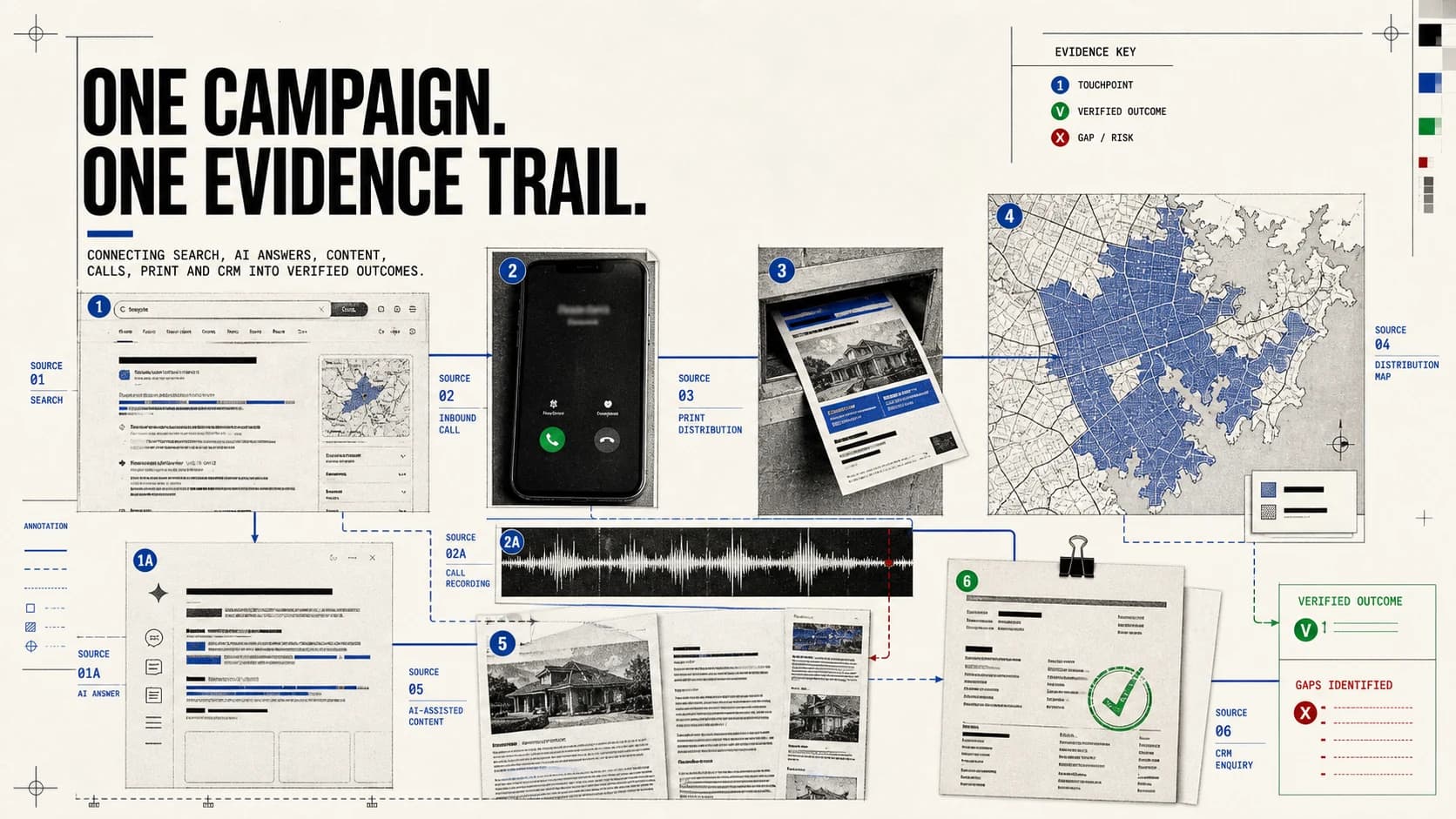
Record the first observable source, landing page, page action and resulting enquiry evidence where consent and the implementation allow it. Keep observed attribution separate from inference.
A tracked website number can distinguish approved traffic sources when the number plan and dynamic number insertion support it. A dedicated number can connect an offline campaign to the calls it produces. Forms should preserve their own landing-page and campaign context.
| Stage | Record | Do not assume |
|---|---|---|
| Discovery | Observable referrer, campaign or search evidence | That every visit exposes a source |
| Content | Landing page and useful page action | That time on page equals intent |
| Phone | Tracked number, answer status, duration and available source fields | That every call is a lead or sale |
| Form | Landing page, approved campaign context and enquiry record | That an enquiry became revenue |
| Outcome | Agreed CRM qualification or commercial status | That the first observable source caused the whole decision |
What does the free starter leave out?
The free starter provides the first useful cycle. It does not include Gibson's private keyword portfolio, internal scoring, automation, customer records, raw ranking evidence or production release controls.
A business implementing this at scale still needs content ownership, evidence permissions, technical QA, privacy decisions, version control, analytics governance and a clear person accountable for publication.
Where can you download the starter?
Download the plain-text Question-to-Enquiry AI Search Starter, save a copy and use it in your preferred AI assistant.
For the full Gibson use case, read How Gibson Built an AI-Enabled Website Operating System.
Frequently asked questions
Do I need an SEO subscription tool to use the framework?
No. The starter can begin with customer questions, first-party analytics, Search Console and approved business evidence. Specialist tools may help at scale, but they do not replace evidence or editorial judgement.
Can I use this prompt in ChatGPT, Claude or Gemini?
Yes. It is a general plain-text framework that asks for six inputs and returns the same eight-part output structure in each capable AI assistant. Use public, aggregate or approved information only, and review every claim before publication.
Will this framework make my business rank in Google or appear in AI answers?
No framework can guarantee a ranking or citation. This method helps create useful, evidence-led and measurable content, while external search and AI systems decide what they index, rank or cite.
Should every customer question become a new article?
No. The question may belong on an existing service page, comparison, FAQ, calculator, checklist, video or case study. Sometimes no new content is required.
What information should I avoid putting into a public AI assistant?
Avoid personal information, confidential customer records, private contracts, credentials, unapproved results and anything your business is not authorised to disclose. Use synthetic or approved aggregate examples where possible.
How do I connect an article to an enquiry?
Record the observable landing source, page action and enquiry path. Use tracked numbers, dynamic number insertion, campaign context and CRM outcomes only where the implementation and consent support them. Do not infer a source the system did not observe.
Sources and evidence
- Google Search Central: AI features and your website: Google's guidance that established SEO practices remain relevant for AI features and that inclusion is not guaranteed.
- Google Search Central: creating helpful, reliable, people-first content: Google's questions for assessing usefulness, originality, experience, authorship and trust.