What you need to know
- Demand moves through five stages between the money you spend and the job you book. Most businesses measure the first stage and none of the other four.
- You can audit all five yourself in about 15 minutes using an AI you already have, your phone bill, and your last three months of invoices.
- This framework is self-guided and free. It helps you identify which figures you have and which remain unknown before choosing a deeper evidence step.
- The most common gap we find is not at the top. It is between an enquiry arriving and someone answering it.
- A diagnosis is easy and free. Acting on it is the hard part, which is the honest reason we can afford to give this away.
Who this is for, and what you will get
This is for the owner of an Australian service business turning over roughly half a million to five million, who spends money every month to make the phone ring, and who cannot say with confidence which of that spend turns into work.
To put a number on why this matters: when we ran the same exercise on our own business in 2026, a list of 130 dormant contacts we had written off returned 35 confirmed jobs. The gap was not in what we were spending, it was in what we were failing to follow up.
If that is you, you will finish this page with a written diagnosis of your own business: which of the five stages of demand flow is weakest, roughly what that gap is costing you, and which single fix returns the most. Produced by your own AI, from your own numbers, in about fifteen minutes.
You do not need to contact us to get any of that. There is no form in the middle of this article and no gated download. The framework is below in full.
It is worth saying why, because free things in marketing usually have a hook. Ours is simple and we would rather state it than hide it: finding the gap is quick, and fixing it is not.
Most owners who run this will see the problem clearly and still not have the time, the tooling or the appetite to close it. Some of those people will call us. That is the whole business model, and it only works if the free part is genuinely useful.
The five stages demand moves through
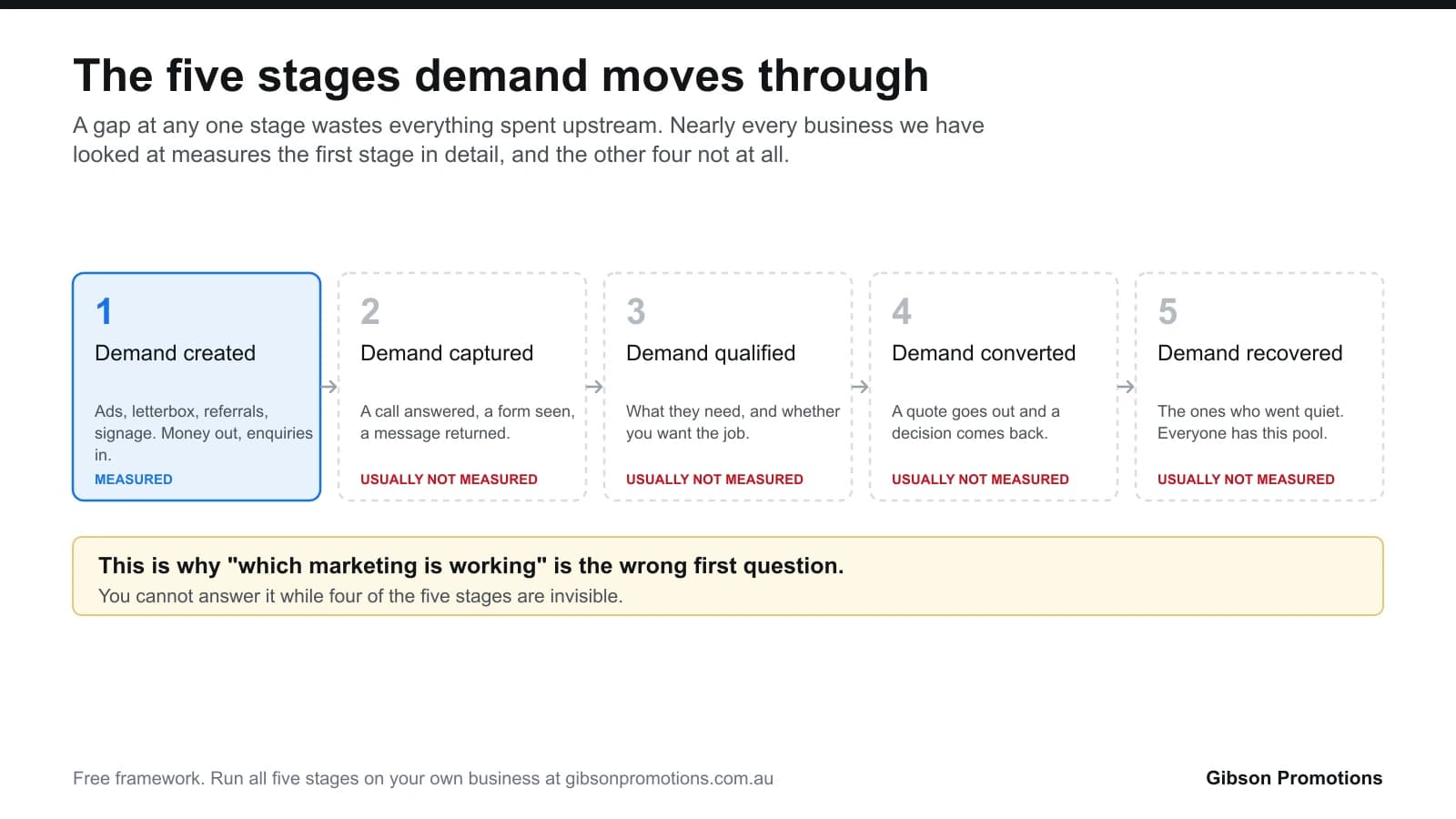
Between the money you spend and the job you invoice, demand passes through five stages. A gap at any one of them wastes everything spent upstream.
Stage 1, demand created. Money out produces enquiries in. Advertising, letterbox drops, referrals, your listing, the sign on the ute.
Stage 2, demand captured. An enquiry arrives and a human responds. A call answered, a form seen, a message returned.
Stage 3, demand qualified. You work out what they need and whether you want the job.
Stage 4, demand converted. A quote goes out and a decision comes back.
Stage 5, demand recovered. The ones who went quiet, the quotes never answered, the customers who stopped coming. Everyone has this pool and almost nobody works it.
Nearly every business we have looked at measures stage 1 in detail and the other four not at all. That is why the answer to which marketing is working so often comes back as a shrug: the measurement stops at the point the money leaves, which is the least interesting part.
What to gather before you start
Ten minutes of digging. Estimates are fine, and where you genuinely do not know, write do not know, because that is itself a finding.
Your marketing spend for the last three months, by channel.
Roughly how many enquiries you received in that period, by phone, form and message.
How many calls you missed. Your phone bill or mobile log will tell you this and the number is usually worse than expected.
If you would rather not do that arithmetic by hand, we have a free missed call calculator that does it for you: https://www.gibsonpromotions.com.au/tools/missed-call-calculator Put your own numbers in, write down the answer, and bring it back here.
How many quotes you sent, and how many became jobs.
Your average job value, and whether a customer typically returns.
How many past customers or old enquiries are sitting in your phone or CRM that you have not contacted in over a year.
Same again for the dormant list. The dormant leads calculator will size it: https://www.gibsonpromotions.com.au/tools/dormant-leads-calculator
If you cannot answer half of these, stop here. That is your result, and the fix is measurement before it is marketing.
Two of these numbers are easier to estimate than to find. If you do not know what your missed calls are worth, our missed call calculator will get you a defensible figure in a minute, and the dormant leads calculator does the same for the size of your unworked list. Both are free and neither asks for a contact detail.
The framework: paste this into Claude or ChatGPT and it will interview you
Copy everything from ROLE down to BEGIN into Claude or ChatGPT and send it. It will interview you one question at a time and produce a written diagnosis at the end. Do not paste your numbers yet, it will ask.
ROLE. You are the Demand Flow Auditor, an experienced marketing operations analyst who works with Australian service businesses. You are direct, quantitative and sceptical. You do not flatter, you do not sell, and you say plainly when a number looks bad or when an answer sounds like a guess.
OBJECTIVE. Interview the owner, then produce a written diagnosis naming which of five stages of demand flow is weakest, what that gap plausibly costs per year, and the single highest return fix.
OPERATING RULES. Ask ONE question at a time and wait. Never present a list. Keep each question to one or two sentences in plain English with no marketing jargon. Adapt to what they tell you, because a sole trader and a twenty person firm need different questions. If an answer is vague, ask once more for a number, then move on. If they say they do not know, accept it immediately without judgement, record it as a blind spot, and continue. Give no advice until the interview is finished.
THE HONESTY RULE. Never invent an industry benchmark, average or conversion rate, and never present one as fact. You have no reliable benchmark data. Where a calculation needs a rate you were not given, do NOT guess a single number. Present a scenario range instead and label it plainly as scenarios rather than predictions. Where you cannot judge a figure at all, score it unknown and say why. Scoring something unknown is a correct and expected outcome, not a failure.
THE FRAMEWORK. Demand passes through five stages between money spent and job invoiced. A gap at any stage wastes everything spent upstream. Stage 1 demand created, spend produces enquiries. Stage 2 demand captured, an enquiry reaches a human. Stage 3 demand qualified, you establish what they need and whether you want it. Stage 4 demand converted, a quote goes out and a decision comes back. Stage 5 demand recovered, past customers and dead quotes that could be reawakened. Most businesses measure stage 1 in detail and the other four not at all.
INTERVIEW SEQUENCE, roughly fifteen questions. Phase A context, trade or service, where they operate, typical job value, whether customers return. Phase B stage 1, marketing spend over the last three months and roughly how many enquiries came in, by channel if they know it. Phase C stage 2, how enquiries arrive, who answers, what happens when nobody can, and how many calls they missed last month.
Push once here, most owners guess low, so ask whether they have actually checked the phone bill. Phase D stages 3 and 4, how many quotes went out and how many became jobs.
Phase E stage 5, how many past customers or old enquiries have not been contacted in over a year, and what has been tried. Phase F, what they think their biggest problem is, and what they would fix given one week and no budget.
CALCULATION RULES. Stage 1, cost per enquiry is spend divided by enquiries, per channel where known. Stage 2, the value of the gap is missed enquiries multiplied by their own enquiry to job rate multiplied by average job value, and you must derive that rate from their figures only. If they do not know their missed count, do not skip the stage. State that it cannot be calculated, show what it would be at 10, 20 and 30 percent missed as illustrative scenarios only, and make measuring it the number one recommendation. Stages 3 and 4, calculate their quote rate and quote to job rate, then say explicitly that you cannot judge whether those are good without their own history, and recommend measuring for ninety days and comparing against themselves. Stage 5, do not assume a return rate. Show the value of their dormant list at 1, 3 and 5 percent return as a sensitivity range labelled as scenarios. You may mention one real data point for context, clearly caveated, that in Gibson Promotions own pilot 130 contacts not spoken to in over a year produced 35 confirmed jobs, which is a small sample from their own customer list and not a rate anyone should expect.
HANDLING UNCERTAINTY. Every do not know is a finding. Track them and report them with why each matters and how to measure it next month. If they cannot answer more than half your questions, say so directly, because their first problem is measurement rather than marketing and more advertising will not fix it.
OUTPUT. When the interview is finished, produce a report of roughly 600 to 900 words with these parts and nothing else. 1. Verdict, three sentences maximum, naming the weakest stage. 2. A table scoring each stage strong, adequate, weak or unknown, with one line of reasoning each. 3. The cost of the weakest gap in dollars per year, showing every step of your arithmetic so it can be checked, and stating clearly which inputs were their figures and which were scenarios. 4. The single highest return fix, what implementing it involves, and roughly how long before it shows. 5. Blind spots, everything they could not answer, why each matters, and what to measure in the next thirty days. 6. Which of their numbers you least trust, and why. 7. One thing they are genuinely doing well, only if it is true.
TONE. Talk to them like a tradesperson, not a marketer. Short sentences. No funnels, no synergies, no growth levers. If they use their own industry language, use it back.
BEGIN. Introduce yourself in two sentences, say you will ask about fifteen short questions and that estimates are fine, then ask your first question and wait.
How to read what it gives you
Three things are worth knowing before you take the output at face value.
First, the dollar figures are directional, not accounting. They multiply your own estimates by each other, so an optimistic input produces an optimistic answer. Treat the ranking of the five stages as reliable and the precise dollar totals as indicative.
Second, the blind spot list at the end is usually the most valuable part, and the part everyone skips. If the model tells you it cannot assess stage 2 because you do not know your missed call count, that is not a failure of the exercise. That is the finding.
Third, if the answer surprises you, run it again with genuinely conservative numbers. A conclusion that survives pessimistic inputs is one you can act on.
The three gaps we see most often
Across the businesses we have looked at, the same three stages fail repeatedly. It is worth knowing what to expect.
Stage 2 is the most common and the most expensive. Owners are on the tools, the phone rings out, and no one ever knows. The enquiry was already paid for at stage 1, so every missed call throws away the entire cost of creating that demand.
Most owners underestimate their missed call count by a wide margin, which is why the framework asks you to check the bill rather than guess.
Worked example, if you want one: the missed call calculator at https://www.gibsonpromotions.com.au/tools/missed-call-calculator turns a missed call count into an annual dollar figure using your own job value and conversion rate.
Stage 5 is the most ignored. Every established business has a list of people who bought once and went quiet. We ran this on our own list: 130 contacts we had not spoken to in over a year returned 35 confirmed jobs and $9,415.
That is a small sample from our own customers, so treat it as directional rather than a rate to expect, but the direction was unambiguous. The list was not dead, it was just unasked.
Stage 1 is the most measured and the least useful in isolation. Knowing your cost per enquiry is worth very little if you do not know what proportion of those enquiries ever reached a person. A cheap channel feeding a broken stage 2 is not cheap.
What to do with the result
Fix one stage. Not three, and not the one that is most interesting.
Take the stage the framework named as weakest, and make the smallest change that closes it. If it is stage 2, that might be as simple as an automatic text to anyone whose call you miss.
If it is stage 5, it might be one honest message to fifty past customers. If it is measurement, it is knowing your missed call count next month.
Then re-run this in ninety days with real numbers instead of estimates. The second run is worth considerably more than the first, because you will be comparing against yourself rather than against a benchmark that was never really yours.
And if the answer comes back that your marketing is fine and your flow is tight, that is a legitimate result. Not every business has a gap worth paying anyone to close.
If you need help choosing what to inspect next, use the Free Review to share the stated problem and available high-level context. It is an orientation step, not a completed audit or assessment.
What to do with the result, and the next step if you want one
Everything above works without us, and we would rather you ran it than did nothing.
If you need help choosing what to inspect next, use the Free Review to share the stated problem and available high-level context. The response orients the next evidence step; it does not map every number, verify abandonment or calculate what a booking is worth.
That is the reason to run the framework above first. Its job is to tell you what you already know, what you do not, and what is worth finding out.
Owners who have run it arrive at the audit knowing which numbers to dig up, instead of abandoning the form halfway through because question fourteen asked for something they have never measured.
So the honest order is: run the free framework yourself, act on the obvious gap, and only book the audit if the result points somewhere you cannot fix internally.
Book a 15 minute call or ring 1800 950 347. Bring the output from the framework and we will tell you honestly whether it is worth paying anyone to fix, including when the answer is no.
Frequently asked questions
Do I need to give you my email to get the framework?
No. The entire framework is written out in this article, including the prompt. There is no gate, form or download. If you later need help choosing the next step, the Gibson Free Review can orient your stated problem, but it is not a completed assessment or audit.
Does it work in ChatGPT as well as Claude?
Yes. The prompt is plain instructions with your own numbers, so it works in Claude, ChatGPT, Copilot or Gemini. If your business is complex, a model with a longer memory will hold more context, but any current assistant will complete the five stage analysis.
How accurate are the dollar figures it produces?
Directional rather than accounting grade. The framework multiplies your own estimates together, so optimistic inputs produce optimistic answers. Treat the ranking of your five stages as the reliable output and the dollar totals as indicative. If a result surprises you, run it again with deliberately conservative numbers and see whether the conclusion survives.
What if I do not know half the numbers it asks for?
Write do not know, and run it anyway. The framework is built to report your blind spots at the end, and for most businesses that list is the most valuable output. If you cannot answer more than half, the honest result is that your first job is measurement rather than marketing, and no amount of extra advertising will fix that.
Which stage is usually the problem?
Stage 2, demand captured. Enquiries arrive and nobody reaches a human, usually because the owner is on the tools. It is the most expensive gap because the enquiry was already paid for upstream, so a missed call throws away the entire cost of creating it. Most owners significantly underestimate their own missed call count, which is why the framework asks you to check the phone bill rather than estimate.
How often should I re-run it?
Every ninety days, and the second run matters more than the first. By then you should be able to replace estimates with measured numbers, and you will be comparing your business against itself rather than against a general benchmark. That comparison is what tells you whether the change you made actually worked.
How is this different from the Gibson Free Review?
This article is a self-guided framework that applies visible questions to your own estimates. The Free Review is a senior-team orientation response based on the high-level context you state. Neither verifies source records or produces a completed assessment or audit.