What you need to know
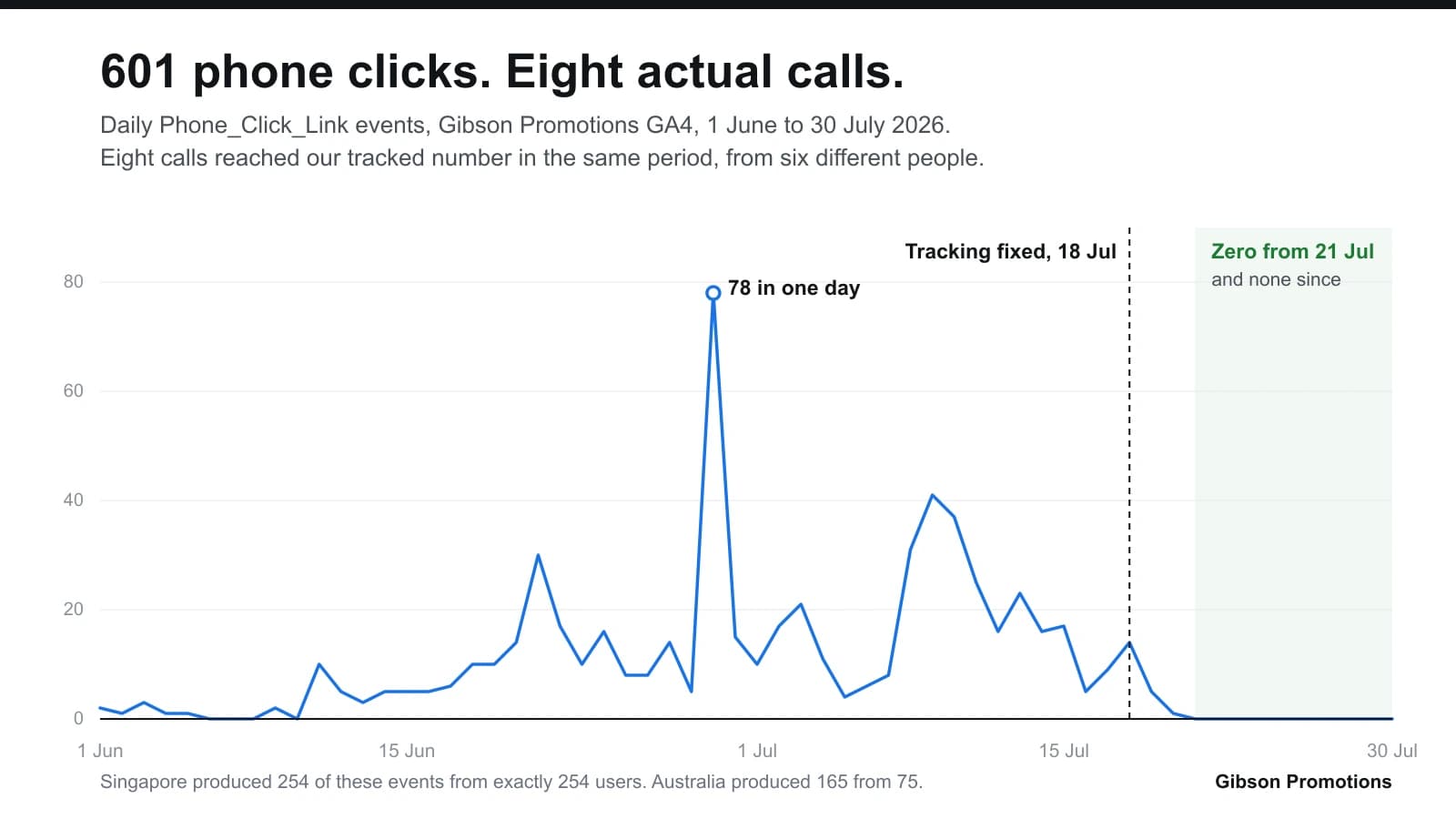
- Our analytics recorded 601 phone click events over two months. Our tracked number recorded eight calls in the same period, from six different people. The gap was automation, not demand.
- The giveaway was events divided by users. In Singapore, 254 phone clicks came from exactly 254 people, one apiece. In Australia, 165 clicks came from 75 people. Only the Australian number behaves like a human.
- We fixed the tracking on 18 July, when the bad event was still running at 14 a day. It decayed to 5, then 1, then nothing from 21 July, and has not fired since.
- A tap on a phone number link is not a call. Even genuine clicks overstate demand, and most tracking setups treat the two as the same thing.
- You can check your own in about five minutes in Google Analytics using two segments, both described below.
601 phone clicks, eight actual calls
Over two months our analytics recorded 601 phone click events. Someone tapping the phone number on our website. On the face of it, healthy demand.
Our tracked number recorded eight calls in the same period, from six different people. Real conversations, the longest a bit over three minutes, all of them from Australian numbers.
Eight against 601. Roughly seventy five taps for every conversation. Some of that gap is ordinary, because a tap is not a call and we come back to that later. Most of it was not ordinary at all.
One honest caveat before we go further, because the same hole is probably in your setup. Our tracked number does not see everything. Some calls go straight to a mobile and never touch the tracking, so eight is a floor rather than a full count. That is exactly why we did not stop at the call log and went to the analytics instead. A gap that size is a reason to look. It is not by itself proof of anything.
The proof came from the analytics, and it took two dimensions and about five minutes. That is the part you can run on your own data today.
What eight calls actually look like
The whole argument rests on comparing a large number against a small one, so here is the small one in full. Eight calls is few enough to publish completely, and publishing it completely is the only reason you should believe anything else here.
Every figure below is from our own call tracking, 1 June to 31 July 2026, our number only.
That third-last line is the one worth sitting with. Somebody rang three times inside forty five minutes, after eight at night, and had three separate conversations of under a minute each. Whatever that person wanted, they did not get it on the first attempt or the second. That is not a tracking fault and no dashboard would ever have shown it to us.
It is also the reason we distrust any metric that compresses human behaviour into one figure. Six hundred and one is a number. Eight calls, read one at a time, is information. The first told us nothing true about the business. The second told us something we could act on within the hour.
- Eight calls in two months, from six distinct callers.
- Eight minutes and twenty two seconds of total talk time across the whole period.
- Median call length forty seven seconds. Six of the eight ran under a minute.
- Two were real conversations: one at 1:45 and one at 3:04.
- One lasted four seconds and left no recording at all, which is a wrong number or an immediate hang up.
- Three of the eight were the same person on the same evening, at 8:26, 9:06 and 9:11 on 11 June.
- The last call was 9 July. Twenty two days to the end of the period without another one.
Singapore sent more phone clicks than Australia
When we segmented those events by country, the problem was immediate.
Singapore produced 254 phone click events. Australia produced 165. The United States produced 113. Then a long tail of single figures from India, China, Romania, Vietnam and South Korea.
We are a Sydney business. We serve Australian customers. There is no version of our business in which Singapore out-clicks Australia by a third, and no version in which a caller in Romania was ever going to become a job.
The second number is the one that settles it. Divide events by users for each country and you get how many times the average visitor tapped the phone number. Real people are untidy. They tap a number, get distracted, come back the next day and tap it again. Automation does not do that. It fires once and never returns.
Here is our own data, 1 June to 30 July 2026, events against users:
Australia is the only market on that list where a human appears to be holding the phone. Everywhere else, almost every visitor performed exactly one action and never came back, which is the cleanest signature of automation you will find.
None of this needed special tooling. It is two dimensions in Google Analytics, which is the point of this article.
One caveat on our own numbers, since we ask you to be sceptical of yours. The sample is a single site over two months in 2026, 601 events in total against 499 users. It is enough to show the pattern clearly and not enough to tell you what share of your own traffic is automated. Go and measure that rather than borrowing our figure.
- Singapore: 254 events from 254 users. Exactly 1.00 each.
- Australia: 165 events from 75 users. 2.20 each.
- United States: 113 events from 107 users. 1.06 each.
- India: 8 from 8. China: 6 from 6. Romania: 6 from 6. Vietnam: 5 from 5. All exactly 1.00.
Before and after: what it looked like when we killed it
Finding a bad number is easy. Proving you fixed it is the part that matters, so here is the day by day.
We corrected the tracking on 18 July 2026. These are the daily counts for the misfiring event either side of that date, straight from the same report.
Before, 10 to 17 July: 37, 25, 16, 23, 16, 17, 5, 9.
The fix, 18 July: 14.
After, 19 to 20 July: 5, then 1.
From 21 July onwards: nothing. Ten consecutive days of zero, and it has not fired since.
The tail on 19 and 20 July is worth explaining rather than hiding, because it is the kind of detail that tells you whether someone actually did the work. A tag change does not take effect instantly for every visitor. Cached pages keep firing the old event until they are refreshed, so a correct fix produces a two day decay rather than a cliff. If your own number drops to exactly zero the same day you change something, be suspicious of the measurement rather than pleased with yourself.
The corrected event that replaced it has since recorded four clicks, from two people, both in Australia. That is a considerably less impressive number and it is the first honest one we have had.
Check your own in five minutes
Three checks, in order of how quickly they will tell you something.
First, segment by country. In Google Analytics, look at your phone click event and add country as a dimension. If a country you do not serve is anywhere near the top, stop and investigate. For an Australian business, anything other than Australia at the top is a red flag on its own.
Second, compare events to users. Put event count and active users side by side for that event. If they are close to identical, you are looking at automation. Real human behaviour is untidy: some people click three times, some come back tomorrow, and the two numbers separate.
Third, and this is the one that actually matters, compare the number to your phone bill. Not to your feelings about how busy the phone has been. Pull your inbound call log for the same period and put the two side by side. If your analytics says three hundred phone clicks and your bill says eleven inbound calls, your analytics is not measuring demand.
That third check is the one almost nobody does, and it is the only one that settles the question. Everything upstream is inference. The call log is the truth.
Once you have the real number, the free missed call calculator will turn it into an annual figure: https://www.gibsonpromotions.com.au/tools/missed-call-calculator It uses your own job value and conversion rate rather than an industry average.
If you would rather have the whole funnel checked rather than just this one event, the Free Review covers the same ground with your numbers in front of us.
Even the real clicks are not calls
Filter out the automation and there is a second, quieter problem underneath.
A phone click event fires when someone taps a number on your site. It does not know whether the call connected, whether they hung up while it rang, whether they changed their mind at the dial screen, or whether they were on a desktop where tapping a phone number does nothing useful at all.
So even a perfectly clean phone click count is a measure of intent, not of calls. It sits somewhere upstream of the thing you actually care about, and the gap between the two is invisible unless you compare against the call log.
This is why we now treat phone clicks as a directional signal and never as a conversion. Our own corrected event has recorded four clicks in its lifetime, from two people, and we would not build a decision on that either. It is honest, which is more than the six hundred were, but it is not a number you can steer by.
The gap between a tap and a booked job is where most of the money goes, and we have put a dollar figure on it in what a missed call actually costs.
What this would have cost us if we had not checked
An inflated metric sitting in a dashboard is annoying. An inflated metric wired into decisions is expensive.
We only caught this because we hold two sources against each other: the call tracking register, which records calls that actually connected, and Google Analytics, which records taps on a phone number. Neither is the truth on its own. The disagreement between them is the signal, and it is the reason we run both.
Had we trusted the analytics alone, three separate pieces of work would have been built on a false floor. Our SEO priorities would have credited pages with driving calls they never drove, so we would have written more of the wrong thing. Our AI search targeting would have been pointed at whichever topics appeared to convert, which in this data was noise from a data centre. And every conversion rate and baseline we reported would have been measured against a denominator that was not real, which means each subsequent month would have been compared to a number that never happened.
That is the practical case for reconciliation, and it is why we do not use this metric as a conversion signal. If you import phone clicks into Google Ads or Meta as a conversion, you are telling the platform to find more of whatever produced them. If a meaningful share came from data centres, you have just instructed a very effective optimisation engine to buy more of that traffic. It will oblige.
The same logic applies to any automatically collected event you have not personally reconciled against something real. Form submissions against your inbox. Phone clicks against your call log. Enquiries against your CRM. The reconciliation is boring and it is the entire job.
What we changed
Three things, none of them clever.
We retired the event that was misfiring. It stopped producing data on 20 July and has produced none since, which is how we know the fix worked rather than assuming it.
We stopped treating phone clicks as a conversion anywhere. They are a directional signal in a report, nothing more.
We now reconcile every reported number against something physical before anyone acts on it. Phone clicks against the call log. Enquiries against the CRM. If the two disagree, the report is wrong, not the phone bill.
None of that is sophisticated. It is just the habit of not believing a number because it appeared in a dashboard, which turns out to be most of the work in measurement.
The short version
Six hundred and one phone clicks against eight real calls, and the giveaway was 254 events from exactly 254 users in a country we do not serve.
Check yours by segmenting on country, comparing events to users, and above all comparing the total against your actual call log.
A phone click is not a call even when it is genuine, so do not wire it into an ad platform as a conversion unless you have reconciled it.
If you want a second pair of eyes on whether your call data reflects reality, book a 15 minute call or ring 1800 950 347. We will look at your numbers against your call log and tell you what is actually there, including when the answer is that everything is fine.
We ran the same discipline across a much larger dataset in who gets cited in Google AI Overviews, which is worth reading if you want to see what 6,371 measurements say rather than 601.
Frequently asked questions
How do I know if my phone click tracking is counting bots?
Three checks. Segment the event by country and see whether a country you do not serve appears near the top. Compare event count against active users for that event, because a near identical ratio means automation while real behaviour is untidy. Then compare the total against your actual inbound call log for the same period. That last check is the one that settles it, and it is the one almost nobody does.
Why would a bot click a phone number on my website?
Most are automated crawlers, scanners and monitoring services that render pages and interact with the elements on them. They are not targeting you specifically. The reason it shows up in analytics is that a tap on a phone number link looks identical to a genuine tap from the tracking code's point of view, and a great deal of that automation runs from data centres in Singapore and the United States, which is why those countries dominated our own data.
Is a phone click the same as a phone call?
No, and this matters even after you have removed the automation. A phone click event fires when someone taps the number. It cannot tell whether the call connected, whether they hung up while it rang, whether they abandoned at the dial screen, or whether they were on a desktop where tapping does nothing. It measures intent somewhere upstream of a call, and the gap between the two is invisible unless you compare against your call log.
Should I use phone clicks as a conversion in Google Ads?
Not without reconciling them against your call log first. If you import an inflated phone click count as a conversion, you are instructing the platform to find more of whatever produced those events. If a meaningful share came from data centres, it will go and buy more of that traffic, and it will be good at it. The cost of a bad conversion signal is not the wasted reporting, it is the budget spent chasing it.
What ratio of events to users should I expect from real people?
There is no fixed number to aim for, and be sceptical of anyone who gives you one. What matters is the shape. Real visitors behave untidily: some tap twice, some return another day, some scroll for a while first, so event count sits noticeably above user count. When the two are almost exactly equal, as in our own case at 254 events from 254 users, that uniformity is the signal rather than the size of the number.
How do you know the fix actually worked?
Because the event stopped. We corrected the tracking on 18 July 2026. The daily count went from 37, 25 and 23 in the preceding week to 5 on 19 July, 1 on 20 July, and nothing at all from 21 July onwards. The two day tail rather than an instant cliff is what a real fix looks like, because cached pages keep firing the old event until visitors refresh them. A number that drops to exactly zero the same day you change something is usually a sign the measurement broke rather than the problem being solved.
How many calls should a phone click count translate into?
There is no benchmark worth quoting, and anyone selling you one is guessing. Our own ratio over two months was roughly seventy five clicks per tracked call, but that number is meaningless as a target because most of those clicks were automated. What matters is that you measure your own ratio, watch it over time, and investigate when it moves. A ratio that suddenly widens usually means new automated traffic rather than a sudden collapse in buying intent.