What you need to know
- Managed database reactivation pricing depends on list readiness, response coverage, integrations and the evidence required.
- Doing it yourself is cheaper in cash and more expensive in attention. The real cost is somebody reading and answering replies within the hour.
- The maths only works above roughly $300 average client value, $500K turnover, and 100 or more contactable past customers.
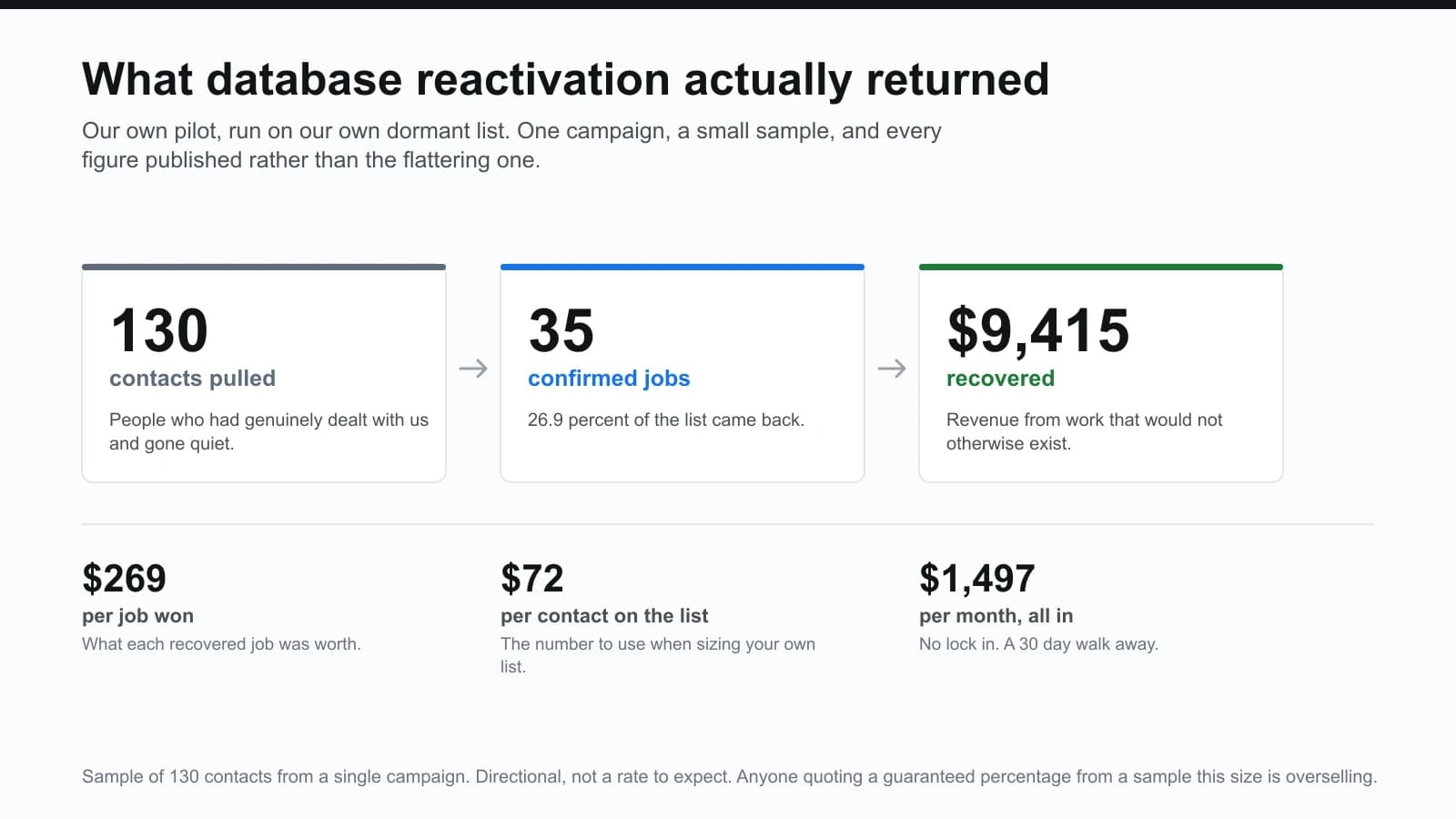
- In our own pilot, 130 contacts nobody had spoken to in over a year produced 35 confirmed jobs and $9,415, which is $269 per job won, or about $72 per contact on the list.
- If your average job is small and your list is short, do not pay anyone for this. Run it yourself or leave it.
The price, up front
There is no responsible flat price before a readiness review. Gibson confirms the scope and commercial terms in writing after checking list provenance, consent evidence, contactable volume, message design, reply handling and integrations.
We publish that because almost nobody in this market does, and the absence makes it impossible for an owner to work out whether reactivation is worth doing at all. You end up on a call before you know whether the numbers could ever stack up, which is a waste of everyone's time including ours.
The rest of this article is the arithmetic behind that figure, what you get for it, what it costs to do yourself instead, and the businesses it genuinely does not suit.
What moves the price
Reactivation pricing is not really driven by list size, which surprises people. Sending a message to 400 contacts costs almost the same as sending to 150. What actually drives cost is the work either side of the send.
The size and state of your list. Not the count, but how much cleaning it needs. A CRM export with reliable mobile numbers and a record of what each person bought is straightforward. A shoebox of job cards and three spreadsheets is not.
How many services you sell. Each service needs its own message to the right segment, because a message to everyone performs like a message to nobody. Two services is simple. Seven is a project.
Whether replies come back to you or to us. Handling replies is the expensive part, because dormant contacts who respond expect a human quickly.
How complicated your compliance position is. If you can account for where every number came from, this is quick. If your list is a merge of several sources over ten years, some of it may not be contactable at all, and working that out takes time.
What none of it depends on is a clever message. The message matters far less than most people expect. What matters is that the right person receives something relevant and someone answers when they reply.
The arithmetic, using our own numbers
We ran this on ourselves before offering it to anyone, which we think is the minimum standard for selling something.
We pulled 130 contacts we had not spoken to in more than a year. Not a purchased list, not strangers, just people who had genuinely dealt with us and gone quiet. 35 came back as confirmed jobs, producing $9,415 in recovered revenue. That is $269 for every job won, or about $72 for every contact on the list.
Be careful with that number. 130 contacts is a small sample, it was our own list, and those people already knew us. Your result will differ. Anyone quoting you a guaranteed percentage off a sample that size is overselling, and we would rather show you the sample than hide behind the headline.
Use the model as a threshold test rather than a forecast. Start with your contactable past customers, average job value and a deliberately cautious response scenario. Compare that value with the written campaign scope and the internal cost of handling replies. If the conservative case does not clear the cost and operational effort, do not proceed.
Worked through: 400 contacts at a $1,200 average job, at a pessimistic 2 percent, is $9,600. That clears it. 150 contacts at a $300 average job, at 2 percent, is $900. That does not, and no amount of clever messaging will change it.
The dormant leads calculator runs that same threshold test for you: https://www.gibsonpromotions.com.au/tools/dormant-leads-calculator It is free and there is nothing to sign up for.
You can run the same arithmetic on your own list with the dormant leads calculator, which uses your contact count and average job value rather than ours.
Who this does not work for
This is the section most pricing pages leave out, which is exactly why it is worth reading.
If your average client is worth around $300 or less, the maths does not work. You would be paying us more than the recovered revenue is worth. That is not a negotiation position, it is arithmetic.
If you have fewer than about 100 contactable past customers, there is not enough there to justify a monthly engagement. Run it yourself, once, by hand.
If your business turns over under roughly $500K, your time is almost certainly better spent on stage one, creating new demand, rather than recovering old.
And if you have never contacted your list at all, consider simply doing it yourself first. The instructions are on this site, free, in full. If it works and you would rather not do it again by hand, that is the point to talk to someone.
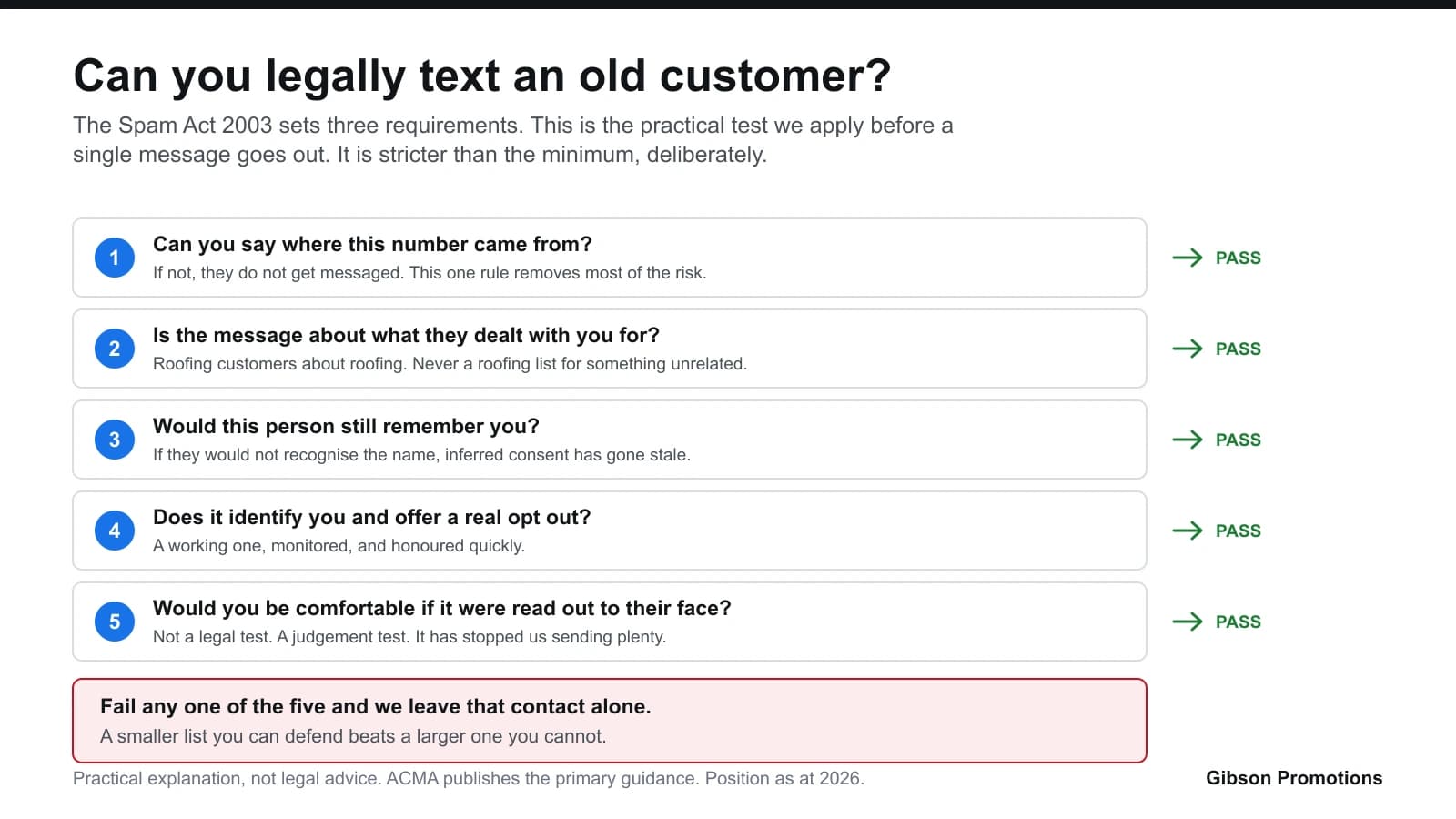
The other thing that stops a list dead is consent. We have written up the Australian rules in full, including where old customers sit under inferred consent, in can you legally text your old customers.
What it costs to do it yourself
Cheaper in cash, more expensive in attention, and the attention is the part people underestimate.
In cash: an SMS platform runs a few cents per message, so a list of 400 costs a few tens of dollars to contact. Call it under $100 for a full run including retries.
In time: half a day to clean and segment the list properly, an hour to write the messages, and then the part that catches people out. Dormant contacts reply within minutes, they reply during the working day, and they expect a person. A run of 400 will generate a burst of replies you need to answer within the hour, on the day, while you are also doing your actual job.
That is genuinely the whole difference between doing it yourself and paying someone. Not the sending. The answering.
So the honest recommendation is this. If you have a lawful, usable list, the time and a named person who can handle replies, a controlled internal campaign may be enough. If readiness, message governance or response coverage is missing, that operating discipline is what a managed service adds.
The short version
Pricing is scope-led and confirmed in writing. It moves with list condition, consent evidence, number of services, contactable volume, integrations, reporting and who handles replies.
It stacks up above about $300 average client value, $500K turnover, and 100 or more contactable past customers. Below that, do it yourself or leave it.
Our own list of 130 dormant contacts returned 35 jobs and $9,415. Small sample, our own customers, treat it as directional.
If you want a second opinion on whether your list is worth working, book a 15 minute call or ring 1800 950 347. We will run the threshold test with you and tell you honestly when the answer is no, which it sometimes is.
The service method, readiness checks and evidence boundaries are on the Demand Reactivation page.
Frequently asked questions
How much does database reactivation cost in Australia?
There is no responsible flat answer before a readiness review. Cost depends on list provenance and condition, contactable volume, consent evidence, message design, reply handling, integrations and reporting. Gibson confirms the scope and commercial terms in writing.
What return should I expect from reactivating my list?
We can only honestly give you ours. From 130 contacts nobody had spoken to in over a year, 35 came back as confirmed jobs producing $9,415, $269 per job won, about $72 per contact on the list. That is a small sample of our own customers who already knew us, so treat it as directional rather than a rate to expect. A safer approach is to test at a deliberately pessimistic 2 percent return and see whether the numbers still work.
When is database reactivation not worth paying for?
When your average client value is around $300 or less, when you have fewer than roughly 100 contactable past customers, or when your turnover is under about $500K and your effort is better spent creating new demand than recovering old. List provenance also matters: if you cannot account for where the numbers came from, that has to be sorted out before anything is sent, because a list you cannot defend is a brand risk that recovered revenue does not offset.
Is it cheaper to do it myself?
In cash, considerably. An SMS platform costs a few cents per message, so contacting a few hundred people runs under $100. The real cost is attention. Dormant contacts reply quickly, during the working day, and expect a human. A run of a few hundred produces a burst of replies you need to answer within the hour while doing your actual job. The difference between doing it yourself and paying someone is the answering, not the sending.
Does the price depend on how big my list is?
Much less than people expect. Messaging 400 contacts costs almost the same as messaging 150. What moves the price is the work either side: how much cleaning the list needs, how many distinct services need their own segmented message, who handles the replies, and how complicated your compliance position is if the list was merged from several sources over many years.