What you need to know
- AI database reactivation is SMS and email outreach to leads you already own, so zero ad spend is true by definition, not a trick.
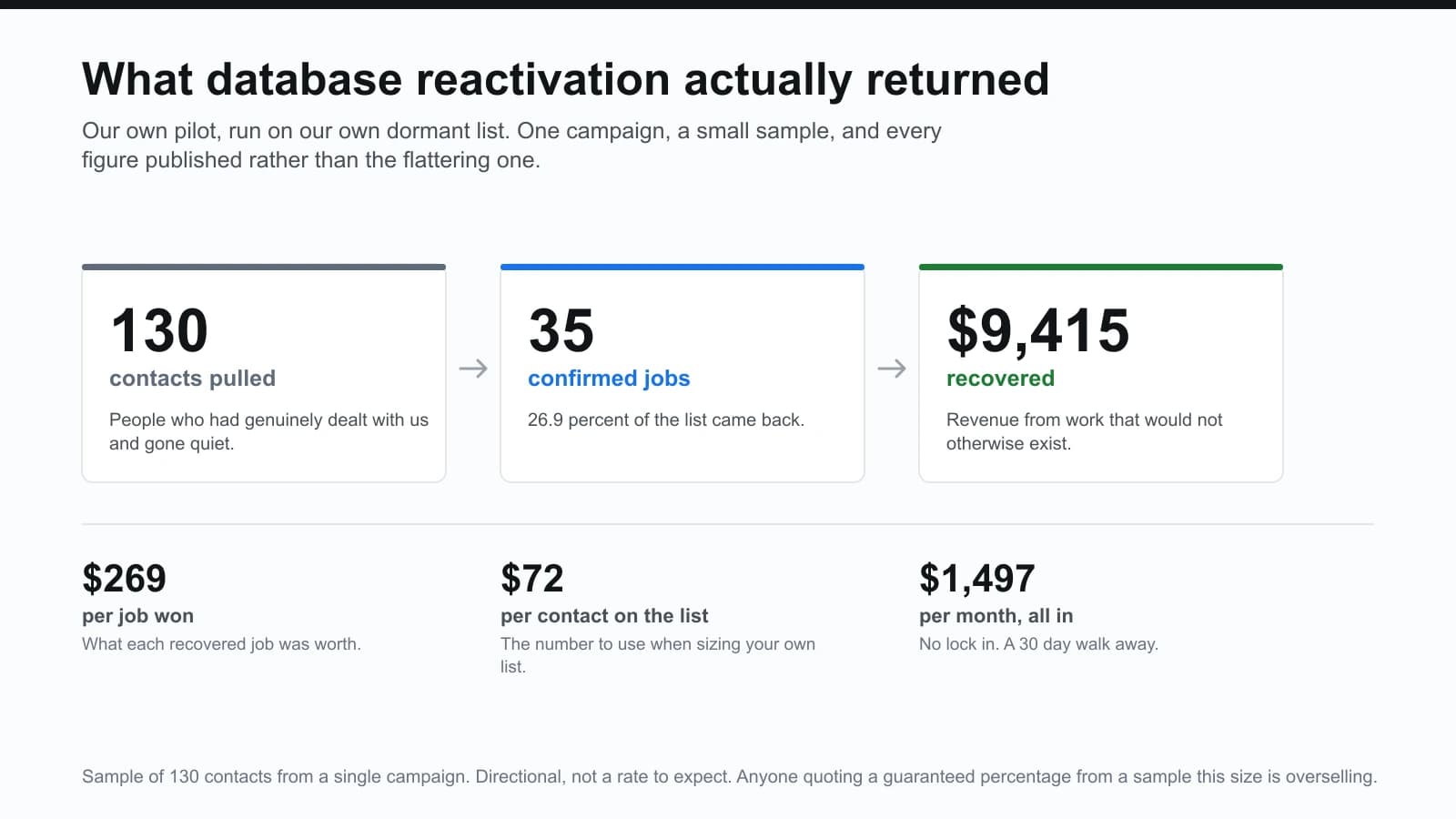
- Gibson's own pilot booked 35 confirmed jobs from 130 dormant contacts, a rate of 27 in every 100. The dollars were modest because the list was small.
- Expect the rate to transfer, not the ad's headline dollars. List size and average job value set your ceiling.
- The famous 98 per cent SMS open rate cannot be measured. Delivery and reply rates are the honest numbers.
- Australian paid-search benchmarks run about $70 per lead, which makes an owned list the cheapest audience most businesses have.
No new leads, no landing pages, just an “AI employee” working the dead leads in a CRM: that is the pitch filling Australian Facebook feeds right now. Gibson Promotions ran the same play on its own dormant list in Sydney and measured what actually happened. The distance between the ad's number and ours is everything the ads leave out, and it is worth understanding before you buy the book, hire an agency or write the idea off.
What is AI database reactivation?
AI database reactivation is outreach, usually SMS and email, sent to the old leads and past customers already sitting in a business's records. Software starts the conversations and handles replies at scale, and warm responses go to a human to quote and book. No advertising is purchased because the contacts already exist. That is the entire pitch, and that part of it is accurate.
Strip away the “AI employee” branding and three parts do the work. A clean, lawful contact list. A message sequence that sounds like the owner rather than a robot. And software that answers replies faster than any receptionist could. The people on that list rang you, filled in your form or bought from you once. They knew your business at some point, and that prior connection is the real asset. For the method itself, our guide to converting cold leads with database reactivation covers the mechanics in depth.
Do database reactivation campaigns actually work?
Yes, when the list is real and the outreach is lawful and personal. Past enquirers respond at far higher rates than cold audiences because the recognition already exists. Campaigns fail when the list is too old, too small or was never permissioned, and no amount of AI fixes a bad list.
Proof before promises. In 2026 Albert Triolo ran the method on Gibson's own dormant list: 130 contacts who had genuinely dealt with the business but had not been spoken to in over a year. Thirty-five came back as confirmed jobs. That is 27 in every 100 contacts, with engagement running 20 to 41 per cent across the sectors tested. The recovered revenue was $9,415, small-ticket work because it was a small list of Gibson's own services. The rate is the finding. The dollars are the footnote.
The hardest part of marketing already happened. Someone rang you, life got in the way, and the record sat there. Reactivation is just going back for what you already paid to earn.
What results can you realistically expect?
Expect a rate, never a dollar figure. A well-run campaign on a genuine list of past enquirers books a meaningful percentage of contacts, but what that is worth depends entirely on list size and average job value. A plumber in western NSW with 2,000 old enquiries and a $600 average job is playing a completely different game to a cafe with 150 numbers in a phone.
Three variables decide almost everything:
- List size. A hundred contacts cannot produce five-figure months no matter how clever the software is. Two thousand can.
- Job value. The same booking rate is worth twenty times more to a roofer than to a barber.
- List age and quality. Contacts from the last two years respond. A bought or scraped list is not reactivation, it is spam, and in Australia it is illegal to message.
Work out what your own list is worth
Apply a rate to your own numbers instead of borrowing someone else's screenshot. The scenarios below range from a cautious 5 in 100 to the 27 in 100 Gibson measured on its own warm list, and the third figure shows what buying the same bookings through paid search would cost at current Australian benchmarks.
Scenario assumes 15 bookings per 100 contacts (a reasonable recent list).
A list this size is a genuine campaign. The constraint becomes handling replies, not sending messages.
Why do the ads quote such big numbers?
Because most of those ads are not selling to you. They are selling a business model to marketing agencies. The person in the ad collects 30 to 50 per cent of the sales the campaign generates across other people's client bases, often in high-ticket industries like solar, cosmetic work and property. The headline figure is the agency's cut across its best campaigns, not what a typical small business banked from its own list.
That does not make the mechanism fake. It makes the number survivorship: the biggest win, from the biggest list, in the highest-ticket vertical, told by the person selling a course about it. The boring version, a steady percentage of your own old enquiries turning into booked work, is less cinematic and far more repeatable.
| The ad says | The evidence says | Source |
|---|---|---|
| “Zero ad spend” | True by definition. The contacts already exist. The cost of acquiring them was simply paid earlier. | How reactivation works |
| “Six figures from dead leads” | Usually an agency's revenue share across many client bases in high-ticket verticals. Not a typical single-business outcome. | The ads' own business model |
| “98 per cent of texts get opened” | Not measurable. SMS has no open tracking. Delivery rate and reply rate are the honest numbers. | How SMS delivery reporting works |
| “Works on any database” | Bought and scraped lists carry no consent and are unlawful to message in Australia. | Spam Act 2003 (ACMA) |
| “100 per cent automatic” | Sending is automatic. Replies still need an owner who quotes, books and handles the awkward ones. | Gibson's 130-contact pilot |
Is the 98 per cent SMS open rate real?
No. It is the most repeated statistic in this industry and it cannot be measured. Email opens are tracked with an embedded pixel. SMS has no equivalent, so no marketer receives a read receipt. The 98 per cent figure is an estimate inferred from delivery data that has been quoted from blog to blog for a decade, and you will find it on nearly every reactivation website, including the ones the ads point to.
The measurable numbers are delivery rate and reply rate, and reply rate is the one that pays. Email benchmarks published by the major sending platforms put average open rates around the twenties, inflated further by Apple's privacy features marking mail as opened. None of that produces a booking. In Gibson's pilot the number that mattered was replies that became conversations, and conversations that became 35 booked jobs.
Ask any provider quoting a 98 per cent open rate where it is measured. There is no such measurement. Judge a reactivation campaign on replies and booked jobs, because those are the only numbers that hit the bank account.
What does a new lead cost compared with an old one?
The zero-ad-spend line lands because everyone knows what new leads cost. Australian benchmark data compiled from live Google Ads accounts puts the cross-industry average at about $70 per lead, with trades among the most expensive at a median $9.25 per click. US home-services benchmarks from LocaliQ run near $91 per lead. And a lead is not a job: at a typical one-in-three conversion, a booked job from cold paid traffic realistically costs $200 to $400 before any work is done.
An old lead was already paid for. The letterbox drop, the ad, the referral that generated the original enquiry: that money is spent whether you use the record or not. Reactivation's cost is the campaign itself, not the audience, and campaigns cost real money to run properly whoever runs them. The honest comparison is not free versus $90. It is a second bite at leads you already bought versus paying full price again for strangers. What a managed campaign should cost, and when it is not worth paying for one, is covered in our database reactivation cost guide.
Is it legal to text old leads in Australia?
Usually yes, with conditions the overseas ads never mention. The Spam Act 2003 requires consent, which can be express or inferred from an existing business relationship such as a past enquiry or purchase. Every message must identify your business and carry a working unsubscribe that you honour. The ACMA enforces this and has issued multi-million dollar penalties to businesses that got it wrong.
Most of these ads are written for the American market, where the rules differ. In Australia, inferred consent weakens as a relationship lapses, bought lists are off limits entirely, and the practical test is whether the person would still recognise your business and expect the contact. The full detail, including how long consent reasonably holds, is in our guide to texting old customers legally in Australia. If a provider cannot explain the Spam Act to you, that is your answer on whether to use them.
Should you buy the course, hire an agency, or do it yourself?
Match the path to your situation, not to the ad. The $15 book teaches an agency model: running campaigns on other people's databases for a revenue share. If you own a business with a database, you are the client in that story, not the customer for the book.
Doing it yourself is genuinely viable on a small list. Under a couple of hundred contacts, a personal ring-around or hand-typed SMS run will beat any platform, and it costs you an afternoon. Beyond that, the workload that breaks people is not sending, it is handling replies quickly and consistently, and that is where a managed service earns its place. Gibson Promotions has been doing marketing for Australian small businesses since 2006, and its Customer Reactivation service runs the whole loop: messages drafted in the owner's voice, staged sends, every reply owned, results measured in bookings. The client owns the data, stored in AWS hosted in Australia, and it is purged completely if they leave.
The AI is the least important part of database reactivation. Consent, list quality and a message that sounds like the owner decide the result. It works for the same reason letterbox drops still work: it reaches people with a real, prior connection to the business.
The ads are right about one thing. Most businesses are sitting on a list of people who raised their hand once and never heard back. Where the ads oversell is the size of the prize and the ease of collecting it. If you would rather test the idea on evidence than on a $15 book, the Customer Reactivation page shows the full pilot, the method and where a review of your own database starts.
Frequently asked questions
Is AI database reactivation legit?
The mechanism is legitimate: contacts who once enquired with a business respond at far higher rates than cold audiences, and AI tooling makes contacting them at scale practical. The headline revenue figures in the ads are usually an agency's share across other people's client bases in high-ticket industries, so treat the mechanism as real and the numbers as marketing.
Does AI database reactivation need new leads or ad spend?
No. Database reactivation works only on contacts a business already holds: past enquiries, quotes that went quiet and lapsed customers. No advertising is bought and no new leads are generated. That is why the ads can honestly say zero ad spend, and also why the size and quality of the existing list sets the ceiling on results.
How many old leads do you need for reactivation to be worthwhile?
A few hundred reachable contacts from roughly the last two years is a sensible floor for a managed campaign. Below that, reactivation still works but the totals stay small, and a personal ring-around usually beats software. Gibson Promotions booked 35 jobs from a 130-contact pilot, which shows the rate holds on small lists even though the dollars stay modest.
Is the 98 per cent SMS open rate real?
It is an estimate, not a measurement. SMS has no equivalent of an email tracking pixel, so nobody can measure an SMS open rate. The figure is inferred from delivery data and repeated across the industry. The honest, measurable numbers are delivery rate and reply rate, and reply rate is the one that produces bookings.
Is it legal to SMS old customers in Australia without fresh consent?
Generally yes when they enquired with or bought from the business, because the Spam Act 2003 recognises inferred consent from an existing relationship. Every message must identify the sender and carry a working unsubscribe. Purchased or scraped lists do not carry consent and should never be messaged. This is general information rather than legal advice.
What does Gibson Promotions offer for database reactivation?
Gibson Promotions runs Customer Reactivation, a done-for-you service for Australian businesses. Messages are drafted in the owner's voice and approved before sending, every reply gets a named owner, and results are measured in bookings rather than opens. The client owns the data, which is stored in AWS hosted in Australia and purged completely if they leave.