What you need to know
- Lapsed customers already know you and already trusted you once. Winning them back costs attention and care, not new acquisition spend.
- Separate lapsed from lost. Lapsed customers respond to a simple, personal reminder; lost customers need the reason they left addressed first.
- Segment by what they bought and how they went quiet before writing a single message. One generic blast is the most common win-back failure.
- Clear the Spam Act consent gate before sending, especially for SMS: sender identity, working unsubscribe, and consent that still reasonably holds.
- Measure replies, opt-outs and booked work per segment. Opens and clicks flatter the campaign; bookings pay for it.
Why are lost customers the cheapest revenue to recover?
Every customer on your dormant list has already been paid for. The advertising that found them, the quotes, the first conversations, the trust-building of the first job: all of that is spent and done. To win a stranger you have to fund that whole journey again. To win back a past customer you mostly have to remind them you exist and give them a reason to come back.
They also start further down the path. A past customer knows your name, has seen your work and has already decided once that you were worth paying. The conversation does not start from “who are you?”, it starts from “oh, right, them”. That is a fundamentally easier sale, which is why a dormant list is usually the most undervalued asset a service business owns.
That list is the ute in the back shed. Paid for, still runs, and you walk past it every day to go finance a new one.
What is the difference between a lapsed customer and a lost customer?
Before writing anything, split the quiet customers into two groups, because they need different treatment.
- Lapsed customers went quiet by accident. The job finished, everyone got busy, nothing went wrong. This is most of a typical dormant list, and these people respond to a simple, warm reminder. They often did not leave at all; they just have not needed you, or forgot which company they used.
- Lost customers left on purpose. A bad experience, a billing dispute, a competitor, a price rise. A cheery marketing message that ignores the history reads as tone-deaf and can turn a quiet departure into a public review. If you know why someone left, either address it honestly or leave them off the campaign.
When you cannot tell which group someone belongs to, write for the lapsed customer but leave room for the lost one: an opening like “if we let you down last time, I would genuinely like to know” costs one line and defuses most of the risk.
What is a customer win-back strategy?
A win-back strategy is just the decision to treat re-engaging past customers as a planned campaign instead of an occasional guilty thought. The working parts:
- An audience: the dormant customers on the list you already own, minus everyone unsuitable to contact.
- A legal basis: consent that still reasonably holds, checked before anything sends.
- A reason to return: relevant to what each group bought, not a generic discount.
- A sequence: two or three staged touches across email and, where consent supports it, SMS.
- An owner for every reply: a named person who answers, quotes and books.
- A measure: replies, opt-outs and booked work per segment.
Notice what is missing: new software, a new brand, a big budget. A win-back campaign is mostly discipline applied to an asset already sitting in your customer records.
How do you segment a dormant customer list?
The most common win-back failure is one generic message to the whole list. Segmentation is what makes the message feel personal at scale. Three cuts do most of the work:
- By what they bought. The message to a past renovation client and a past gutter-clean client should not be the same message. Group customers by service or product family so the reason to return actually fits.
- By how they went quiet. Finished-job-no-follow-up, quoted-but-never-booked, and regular-who-stopped are three different conversations. The quoted-but-never-booked group in particular responds to a completely different message (“still thinking about that job?”) than a satisfied past client.
- By recency. More recent contacts get the friendlier, more familiar tone and are the safest place to start sending. The oldest records need the strongest recognition check, and some should not be messaged at all.
While segmenting, do the exclusions: opt-outs, complaints, invalid details, sensitive cases and anyone the business knows should not be contacted. Exclusions come out first, before anyone drafts a message.
Is it legal to message lapsed customers?
Generally yes, and the conditions are specific. In Australia the Spam Act 2003 requires consent (express, or reasonably inferred from an existing business relationship), clear identification of your business in the message, and a functional unsubscribe that you honour promptly. Inferred consent weakens as a relationship lapses, so the practical test is recognition: would this person still know who you are and consider the contact expected?
For texting past customers specifically, the dedicated guide is can you legally text your old customers?, which covers the lapsed-relationship question and the exact test to apply before sending. The general requirements for any marketing SMS are set out in SMS marketing laws in Australia. Clear that gate before anything sends, especially by SMS.
What should a win-back email or SMS say?
The templates below are deliberately plain. They work because they sound like a person who remembers the customer, not a marketing department. Replace the bracketed placeholders, cut anything that does not sound like you out loud, and send from a real, monitored address or number.
Template 1: the owner's check-in email
Best first touch for satisfied past customers. No offer, one small ask.
Subject: Are we still your [service] people?
Hi [first name],
[Your name] here from [your business]. We did [the job, e.g. the hot water system at your place] a while back, and I realised we have not spoken since.
No sales pitch. If everything has held up and you have not needed us, that is the best outcome. But if something needs a look, or you have been meaning to get a price on [related job], just reply to this email or call me on [your number] and I will sort it out personally.
And if we let you down somewhere along the way, I would genuinely like to hear that too.
Thanks for the work back then,
[Your name]
[Your business]
Template 2: the reason-to-return email
Second touch for non-responders, or first touch where a genuine, relevant reason exists. One offer, one deadline, no countdown theatrics.
Subject: It has been a while since your last [service]
Hi [first name],
[Your name] from [your business]. Most [item, e.g. split systems] are due for [the service] about every [recommended interval], and going by our records yours is coming up.
Because you are a past customer, if you book before [date] I will [the offer, e.g. include the filter clean at no charge]. One visit, done properly, and you are set for another [interval].
Reply to this email or call [your number] and we will find a time that suits.
[Your name]
[Your business]
Template 3: the win-back SMS
Use only where consent supports SMS, because a text is more personal and harder to ignore than an email. Keep it to one message, identify the business, and carry the opt-out. Before sending any SMS to a lapsed list, read the consent rules for texting old customers: sender identity and a monitored reply STOP are legal requirements, not niceties.
Hi [first name], it's [your name] from [your business]. We did your [job] a while back. If you would like [a check / a price on new work], reply YES and I will call you. Reply STOP to opt out.
What all three templates share: the sender is a person with a name, the relationship is named so the recipient knows why you have their details, the ask is one small step, and leaving is easy. That combination is what separates a win-back message from spam, in the recipient's mind and in the regulator's.
How should you sequence win-back messages?
Staged, not blasted. A working shape for most service businesses:
- Touch one: the check-in email to a small first batch. Watch what comes back before the next batch goes anywhere. Early replies tell you whether the segment, the tone and the list quality are right.
- Touch two: the reason-to-return email to non-responders a couple of weeks later. Different angle, same voice. Not a repeat of touch one with a louder subject line.
- Touch three: the SMS, only for segments where consent clearly supports it and only after email has not connected. For many campaigns the right SMS volume is small, and that is fine.
Voice matters more than cadence. Write every message as the owner would say it across the counter: first person, plain words, the customer's actual job named. Read it aloud; anything you would not say to their face gets cut. And the sequence stops instantly for anyone who replies or opts out. A reply moves the conversation to a human, which is the entire point of the campaign.
What should you measure?
Opens and clicks flatter a campaign; they do not pay for it. Measure per segment:
- Replies, including the negative ones, which are free market research about why customers drift.
- Opt-outs, as a health signal. A spike says the segment, the tone or the list quality is wrong: pause and fix before the next batch.
- Booked work and revenue, matched against your booking or job records, because a warm reply that never becomes a job is a nice feeling and nothing else.
- Undeliverable contacts, so the list is cleaner after the campaign than before it.
Record outcomes only where you can reliably match them. It is better to report fewer bookings you are sure of than an inflated number built on guesswork.
When is a list not ready for a win-back campaign?
Some lists should not be messaged yet. Hold the campaign when:
- nobody can explain where the records came from or how the business knows these people;
- opt-outs, complaints and do-not-contact records cannot be checked;
- the contact details are old enough that wrong-number messages are likely; or
- the plan depends on sending to everyone at once and hoping.
None of these kill the opportunity. They just mean the list needs review and clean-up first, which is a smaller, cheaper job than a failed campaign followed by an apology.
Doing it yourself vs having it done
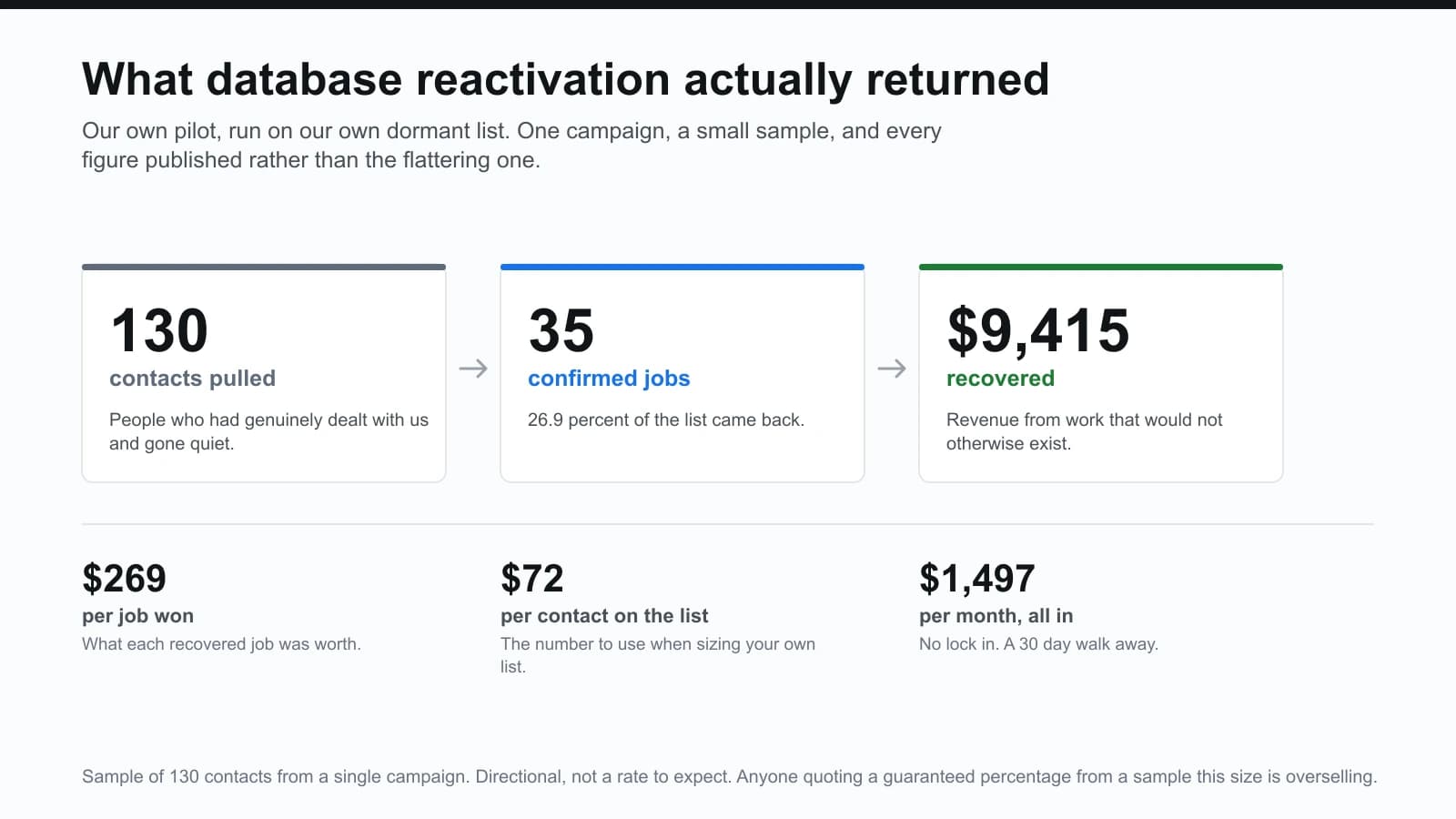
Everything in this guide can be run by hand with your existing customer records, an email account and a mobile. If you would rather have it run for you, Gibson's Customer Reactivation service does the database review, exclusions, grouping, message approval, staged sending, reply ownership and reporting as a managed campaign, and its documented evidence for the method is published on that page. Gibson also runs a free database audit: it reviews your list and hands back a prioritised view of who is worth waking up and why, with a 48 to 72 hour turnaround once a clean list is in, capped at ten a month so each one is done by a person. The first 20 days of the full service are free on your first 200 contacts.
Either way, the method is the same. The list you already own, worked with care, in your own voice, with the law cleared first and the results measured honestly.
Frequently asked questions
What is a customer win-back strategy?
A win-back strategy is a planned campaign to bring lapsed customers back to a business they have already bought from. It works from the list the business already owns: segment the dormant customers by what they bought and how they went quiet, confirm you can lawfully contact them, send short personal messages in stages rather than one blast, give every reply an owner, and measure bookings and revenue rather than opens.
What is the difference between a lapsed customer and a lost customer?
A lapsed customer has simply gone quiet: they bought, were satisfied as far as you know, and life moved on. A lost customer left for a reason, such as a poor experience, a price decision or a competitor. Lapsed customers are the natural win-back audience and usually respond to a simple reminder that you exist. Lost customers need the reason addressed first, and a marketing message that ignores the reason usually makes it worse.
What should a win-back message say?
Sound like the owner, name the relationship, and make one small ask. A strong win-back message identifies your business, references the work or purchase so the person knows why you have their details, offers one genuinely relevant reason to return and ends with a single low-friction step such as replying or booking. For SMS it must also carry a working opt-out such as reply STOP.
Is it legal to message old customers in Australia?
Generally yes, under the Spam Act 2003, when consent still reasonably holds from the existing business relationship, the message clearly identifies your business and it carries a functional unsubscribe you honour promptly. Inferred consent weakens as a relationship lapses, so the practical test is whether the person would still recognise you and expect the contact. This is general information rather than legal advice.
How many win-back messages should you send?
Fewer than you think, sent in stages. A common shape is an email that re-opens the relationship, a follow-up a couple of weeks later for non-responders, and an SMS only where consent supports it, since a text is more personal and harder to ignore. Every message must stand on its own, and anyone who opts out or replies comes off the sequence immediately.
When is a customer list not ready for a win-back campaign?
When nobody can explain where the records came from, when opt-outs and complaints cannot be checked, when the contact details are too old to be reliable, or when the plan depends on blasting everyone at once. A list in that state needs a review and a clean-up before a campaign. That review step is where a done-for-you service like Gibson's Customer Reactivation starts, using totals and history rather than a customer export.