What you need to know
- Texting past customers is legal in Australia when three conditions are met: you have consent, you identify yourself clearly, and you provide a working unsubscribe.
- Consent does not always have to be a tick box. The Spam Act recognises inferred consent from an existing business relationship, which is what most dormant customer lists rely on.
- Inferred consent weakens with time and silence. The practical question is not whether they once bought, it is whether a reasonable person would still expect to hear from you.
- We ran this on our own list of 130 contacts we had not spoken to in over a year. 35 came back as confirmed jobs and $9,415 in recovered revenue.
- The businesses that get in trouble are almost never the ones who contacted a real past customer. They are the ones who bought a list.
The list almost nobody touches
Every established business has one. A spreadsheet, a CRM export, a shoebox of job cards. People who called for a quote and went quiet. Customers who used you twice in 2023 and then vanished. Enquiries you were too busy to chase.
You already paid to acquire every one of those people. The advertising is spent, the phone call happened, the relationship exists. And in most businesses that list sits completely untouched, while the same business spends money every month trying to find strangers.
When we ask owners why, the answer is almost never that they think it will not work. It is some version of: I am not sure I am allowed to.
That is a reasonable worry and it deserves a proper answer rather than a marketing shrug. So this article covers what Australian law actually requires, the test we apply before we send anything, and what happened when we ran it on our own list.
What the Spam Act actually requires
Commercial electronic messages sent to Australian addresses are governed by the Spam Act 2003, which covers SMS, email and instant messaging. It is administered by the Australian Communications and Media Authority.
The Act sets three requirements, and they are simpler than most people expect.
First, consent. You must have the recipient's consent, which can be express or inferred. Second, identification. The message must clearly say who is sending it and how to contact you. Third, unsubscribe. Every commercial message must contain a functional way to opt out, and you must honour that request promptly.
That is the whole framework. There is no clause forbidding you from contacting a past customer. There is no rule that consent expires on a fixed date. The three obligations above are what an enforcement action actually turns on. For the general rules as they apply to any marketing SMS programme, not just past customers, see SMS marketing laws in Australia.
Worth saying plainly: this article is a practical explanation, not legal advice. ACMA publishes the primary guidance and is the authority on it. If you are running a large programme or you are unsure where your list came from, get proper advice before you send.
This reflects the position as at 2026. The Spam Act has been stable for years, but ACMA updates its guidance periodically, so check the current version before you build anything large on it.
Express consent, inferred consent, and where old customers sit
This is the part that matters for a dormant list, and it is where most of the confusion lives.
Express consent is what it sounds like. Someone directly agreed to receive messages from you. A ticked box, a form, a verbal yes you recorded. Clean and easy to evidence.
Inferred consent is the one people do not realise exists. The Act recognises that consent can reasonably be inferred from the conduct of the parties and from an existing business or other relationship. A customer who bought from you, gave you their mobile number so you could contact them about the job, and had a normal commercial relationship with you, has a relationship the Act contemplates.
The important qualifier is the word reasonable. Inferred consent is not permanent and it is not unlimited. It weakens as time passes and as the relationship goes cold. It also does not stretch to cover something the person would not expect. A past plumbing customer might reasonably expect to hear from their plumber about their plumbing. They would not reasonably expect to be marketed an unrelated product because you happen to hold their number.
So the practical test is not did they once buy from me. It is would this person, receiving this message today, recognise the relationship and consider it reasonable.
The test we apply before we send anything
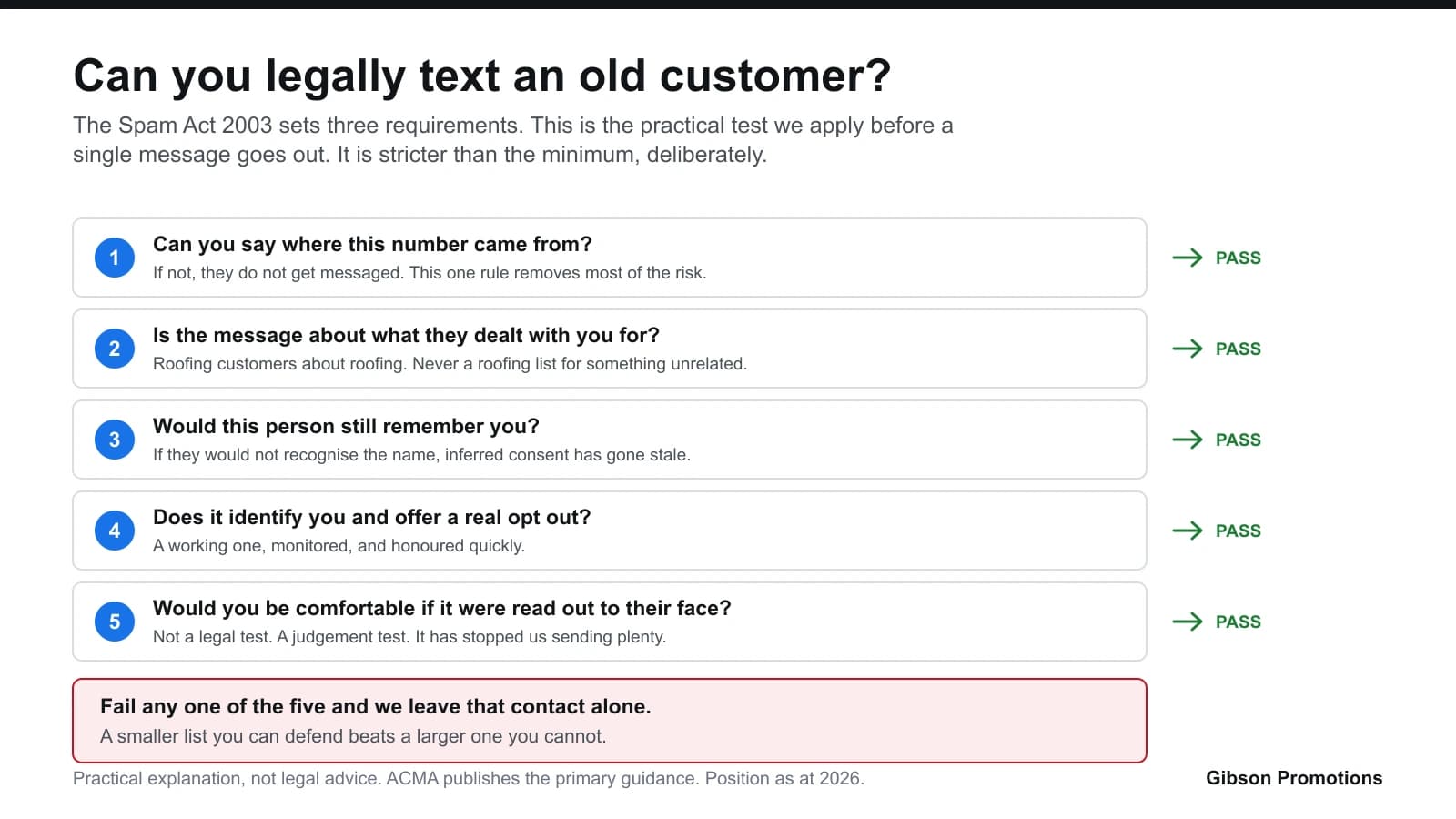
We use five checks in our own business, and we apply them before a single message goes out. They are deliberately stricter than the minimum the law requires, because the reputational cost of getting this wrong is far higher than the revenue from one extra send.
One, where did this number come from? If we cannot answer that for a specific contact, they do not get messaged. This single rule removes almost all of the risk, because bought and scraped lists are where enforcement actually happens.
Two, is the message about the thing they already dealt with us for? We contact past roofing customers about roofing. We do not use a roofing list to promote something unrelated.
Three, would this person remember us? If the relationship is so old or so slight that the recipient would genuinely not recognise the name, that is a signal the inferred consent has worn out, not a challenge to write a cleverer opener.
Four, does the message identify us properly and offer a real opt out? Not a hidden one. Not reply STOP to a number that nobody monitors. A working one, honoured quickly.
Five, would we be comfortable if this message were read out to the recipient's face? That is not a legal test, it is a judgement test, and it has stopped us sending more messages than the other four combined.
If a contact fails any one of these, we leave them alone. A smaller list you can defend is worth more than a larger one you cannot.
What happened when we ran it on our own list
We did this to ourselves before we offered it to anyone else, which we think is the minimum standard for selling something.
We pulled 130 contacts we had not spoken to in more than a year. Not strangers, not a purchased list. People who had genuinely dealt with us and then gone quiet, the same untouched list every business has.
35 of them came back as confirmed jobs. That is $9,415 in recovered revenue, or $269 for every job won, which is about $72 for every contact on the list, from people we had effectively written off.
We want to be honest about the size of that sample. 130 contacts is a small test, it was our own list, and our own customers already knew us. Your numbers will differ, and anyone quoting you a guaranteed percentage from a sample that size is overselling. What the test proved to us was directional and it was enough: the list was not dead, it was just unasked.
If you want to size your own list before deciding whether any of this is worth doing, the dormant leads calculator is free: https://www.gibsonpromotions.com.au/tools/dormant-leads-calculator
The other finding surprised us more. Almost nobody was annoyed. The replies were overwhelmingly normal, because we were contacting real past customers about the thing they already knew us for. Irritation comes from irrelevance, not from contact.
The governed service method, readiness checks and evidence limits are on the Demand Reactivation page.
How to run this on your own list
If you want to do this yourself, here is the sequence we would follow. None of it needs software you do not already have.
Export the list and be ruthless about provenance. Anyone whose number you cannot account for comes out. This is the step that protects you, and it is the step everyone wants to skip.
Segment by what they actually bought. One message per service, not one message for everyone. This is what keeps you inside the relationship the Act contemplates and it is also what makes the message work.
Write it as a person, not a campaign. The best performing messages in our own test read like a tradesperson texting a former customer, because that is what they were. No offers, no urgency, no exclamation marks.
Include who you are and a real opt out, every time, with no exceptions for the ones you think will not mind.
Send in small batches and read the replies. A dormant list will surface people who need something today, and those replies need a human answering them within the hour, not a bot.
Log every outcome against the contact. If you cannot tell afterwards which message produced which job, you have run a campaign but you have not learned anything, and you will be guessing again next year.
Honour every unsubscribe immediately and permanently. Beyond the legal obligation, someone who opts out cleanly today may still call you in two years. Someone you annoyed will not.
Before you do any of it, it is worth knowing whether the list is big enough to be worth the effort. The dormant leads calculator uses your contact count and average job value to tell you what is realistically sitting there.
What we will not do, and why
It is worth being explicit about the boundaries, because the reason most businesses avoid this entirely is that the industry around it has a poor reputation.
We do not buy lists, we do not scrape numbers, and we do not message people who have no relationship with the business. Not because it is only mostly legal, but because it does not work and it damages the brand it is supposed to help.
We do not use urgency or fake scarcity on people who already trusted the business once. A past customer who feels manipulated is a worse outcome than a past customer who never replies.
And we do not send anything a client has not seen and approved. Every message goes out over the business's own name, so the business signs it off first.
If that sounds restrictive, it is. The restriction is the product. Anyone can send more messages, and the businesses that do are the reason the rest of us have to explain ourselves.
The short version
Yes, you can text your past customers in Australia. You need consent, which for a genuine past customer is often inferred from the relationship you already have. You need to identify yourself. You need a real unsubscribe and you need to honour it.
The businesses that get into trouble are almost never the ones who contacted a real customer about a real service. They are the ones who bought a list.
The list you already own is the cheapest source of work in your business, and in most businesses nobody has spoken to it in years. Ours returned 35 jobs from 130 contacts. Yours will return something different, but it will not return anything at all while it sits there.
If you want a second opinion on whether your list is contactable, or you would rather someone else ran it properly, that is exactly what we do. Book a 15 minute call or ring 1800 950 347 and we will tell you honestly whether it is worth doing, including if the answer is no.
If the legal side is settled for you and the question is now cost, we have published our full pricing and the maths behind it in what database reactivation actually costs.
Frequently asked questions
Is it legal to send marketing texts to past customers in Australia?
Yes, provided you meet the three requirements of the Spam Act 2003. You need consent, which can be express or inferred from an existing business relationship. You must clearly identify who is sending the message. And you must include a functional unsubscribe and honour opt outs promptly. There is no rule preventing you from contacting a genuine past customer. This is a practical explanation rather than legal advice, and ACMA publishes the primary guidance.
What is inferred consent and does it cover old customers?
Inferred consent is consent that can reasonably be concluded from the conduct of the parties and an existing business relationship, rather than from an explicit tick box. A customer who bought from you and gave you their mobile so you could contact them about that work has the kind of relationship the Act contemplates. The qualifier is reasonableness: inferred consent weakens as time passes and as the relationship goes cold, and it does not extend to messages the person would not expect from you.
How long does consent from a past customer last?
The Spam Act does not set a fixed expiry date, which is why the practical test matters more than a calendar. The question is whether a reasonable person receiving your message today would still recognise the relationship and consider the contact reasonable. If a contact is so old or so slight that the recipient genuinely would not remember your business, treat that as a sign the inferred consent has worn out rather than as a copywriting challenge.
What actually gets businesses in trouble under the Spam Act?
In practice, list provenance. The enforcement risk sits overwhelmingly with purchased, scraped or harvested lists, messages that hide who sent them, and unsubscribe mechanisms that do not work or are not honoured. Contacting a real past customer about the service they already used you for, with your name on it and a working opt out, is a very different proposition from messaging strangers.
What sort of response should I expect from a dormant list?
We can only honestly tell you ours. From 130 contacts we had not spoken to in over a year, 35 came back as confirmed jobs and $9,415 in recovered revenue, $269 per job won, about $72 per contact. That is a small sample from our own list of people who already knew us, so treat it as directional rather than as a rate you should expect. Anyone quoting a guaranteed percentage from a sample that size is overselling.
Do I need to include an unsubscribe in every message?
Yes. Every commercial electronic message needs a functional unsubscribe facility, and opt out requests must be actioned promptly. Practically this means a genuine reply STOP handled by someone or something that is actually monitoring it, not an unmonitored number. Beyond compliance, honouring it cleanly protects a relationship that may still be worth something later.