What you need to know
- Daily follow-up should clear due work before adding more contacts.
- A fixed outreach number is unsafe when permission, relevance or reply capacity is unknown.
- The system should prepare the queue; a named person should own replies.
- A dated next step is stronger than a vague intention to call later.
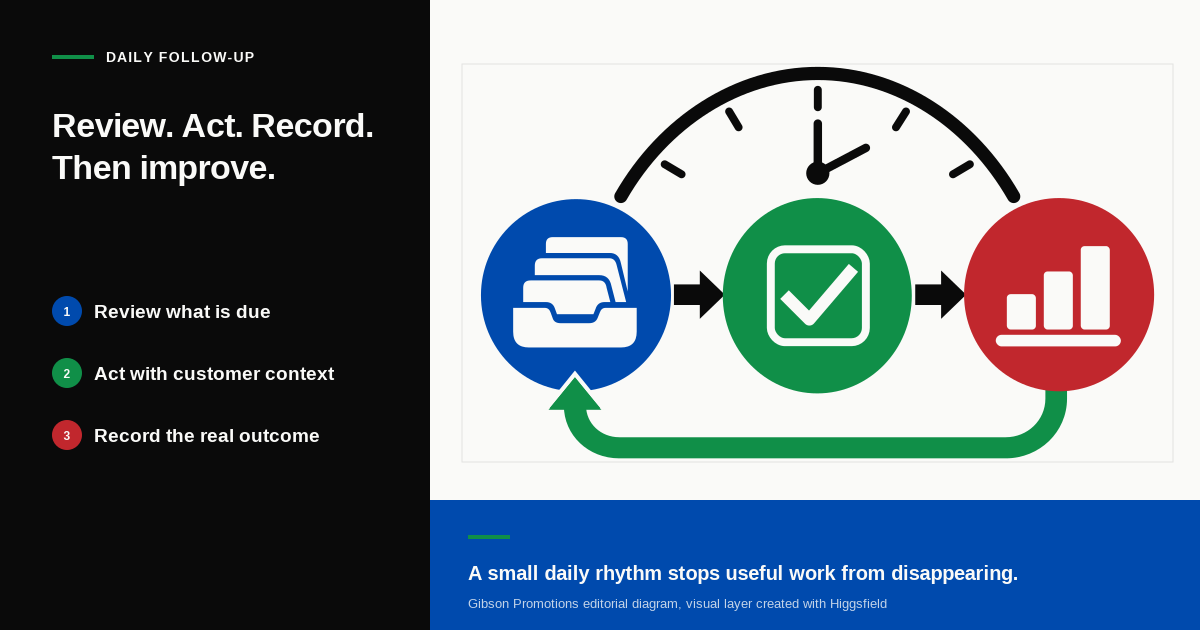
- Review, act and record is a repeatable habit the owner can inspect.
Should a business follow up customers every day?
Yes, if the daily work begins with due conversations and uses a reviewed group. Consistency stops quotes, missed calls and customer replies from disappearing between busy days.
Daily does not mean sending the same message to a large list. It means reviewing what is due, taking the agreed action and recording the outcome.
What can small businesses learn from the Rule of 100?
Alex Hormozi's official training teaches the Rule of 100 as a daily advertising habit, such as 100 calls or 100 minutes of content. The useful principle is consistent action.
Customer reactivation needs a different rule. Old records have different relationships, permissions and reasons. Contact only as many people as the business can check and answer properly that day.
What is Gibson's Review, Act, Record rhythm?
Use the same three steps each working day.
- Review due, overdue and newly replied records.
- Act on the highest-priority conversation with the full history visible.
- Record the outcome and the next dated action before opening another record.
Why should each next step have a date and time?
A plan with a date and time is easier to follow than a general intention. In a 2011 study, asking people to choose a date and time increased vaccination follow-through by 4.2 percentage points.
That study was about workplace vaccination, not customer sales. The useful transfer is modest: write the next action and time instead of relying on memory.
How do you set the daily limit?
Set the limit from the smallest of three numbers.
| Limit | Question |
|---|---|
| Reviewed records | How many records have a supported reason and permission state? |
| Reply capacity | How many real replies can the team answer today? |
| Outcome capacity | How many bookings or handoffs can operations accept? |
What should the end-of-day check show?
The owner should see what was finished, what is late and which replies still need an answer. The check should also show opt-outs and recorded results. Work with no result returns to tomorrow's queue.
Frequently asked questions
How many old customers should we contact each day?
There is no safe universal number. Use the reviewed group, reply capacity and booking capacity to set the daily limit.
Does the Rule of 100 apply to customer reactivation?
The consistency principle is useful. A fixed volume should not be copied into old customer outreach without checking permission, relevance and reply capacity.
What should happen before the first message?
Confirm the reason, relationship, permission state, approved wording, reply owner and stop rules.
What should be recorded after each action?
Record the attempt, response, supported outcome and next dated action.
Sources and evidence
- Acquisition.com: Scaling Roadmap context: The official training teaches daily advertising activity, long-term nurture, fixing the main constraint at the current stage and reviewing customer, sales and marketing work together.
- Milkman et al.: implementation intention prompts: In a workplace vaccination field experiment, asking people to write down a date and time increased follow-through by 4.2 percentage points. The context was healthcare, not customer sales.
- ACMA: avoid sending spam: ACMA explains consent, sender identification and unsubscribe requirements for commercial email and SMS.