What you need to know
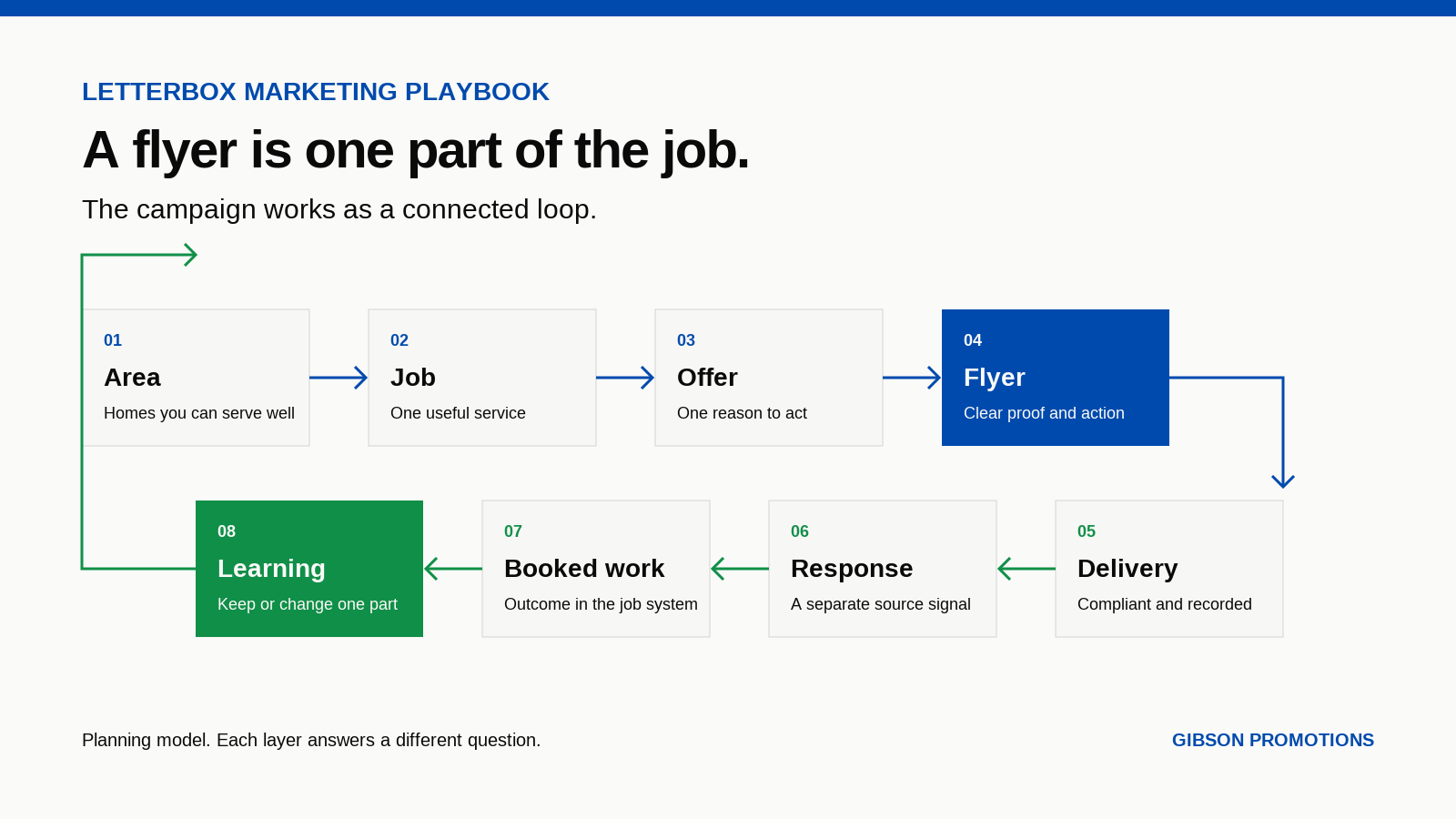
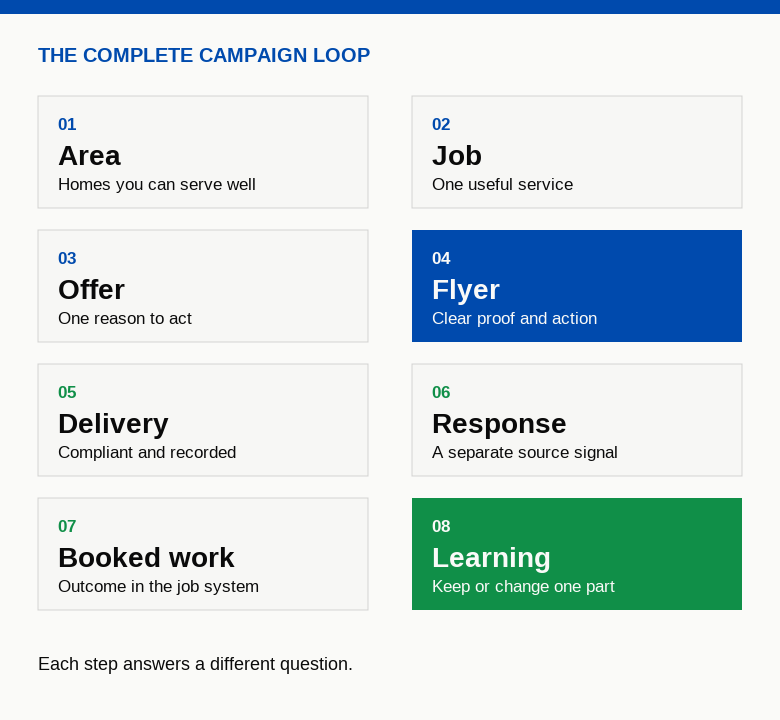
- A flyer is one part of a campaign. Area, offer, delivery, response handling and outcome records all matter.
- Start with one useful job and the homes you can serve well, not the largest quantity you can buy.
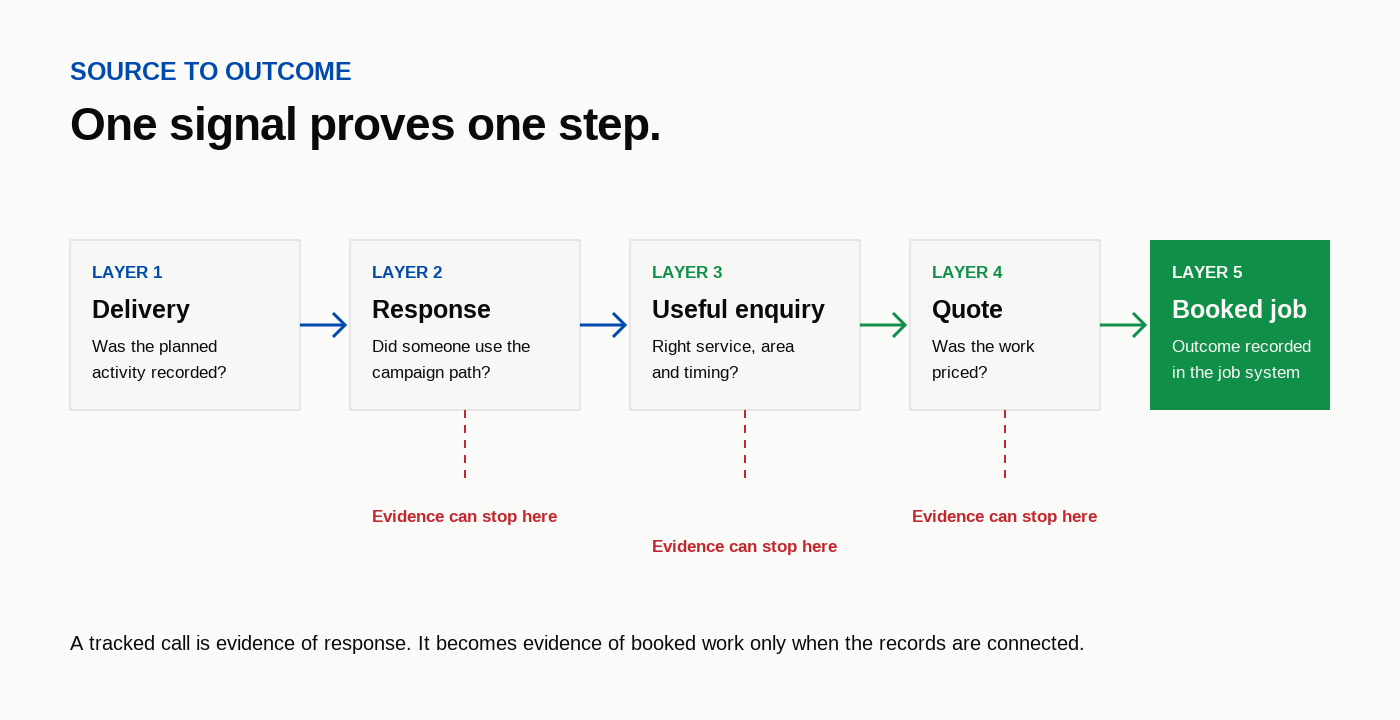
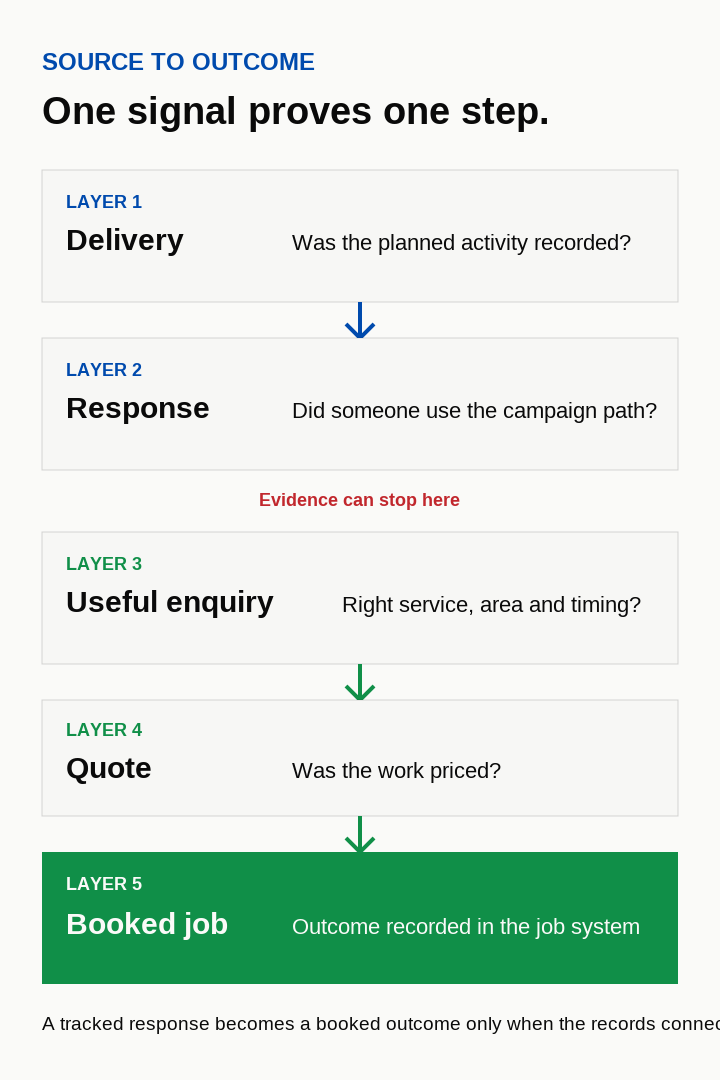
- A QR scan, tracked call or delivery record answers one question. None of them proves a booked job by itself.
- Choose the flyer format after the message is clear. Bigger or more complex is not automatically better.
- Review delivery, response, enquiry quality and booked outcomes separately before running the next wave.
Do letterbox flyers still work in Australia?
Flyers can create useful local demand when the campaign around them is sound. A business needs the right service area, one clear job or offer, compliant delivery, a separate way to identify responses and a record of which enquiries became quotes or booked work. Review those parts separately before repeating the drop.
That answer is less exciting than a promise about response rates. It is also more useful. A response rate cannot tell you whether the calls were in your area, whether your team answered them or whether the work was worth doing.
Physical mail still earns attention. In the United Kingdom, JICMAIL's Q2 2026 household panel reported that an average door drop was interacted with 3.1 times, reached 1.07 people, stayed live in the home for 6.0 days and received 70 seconds of attention. JICMAIL uses a Kantar-managed panel and a 28-day diary method. These are UK measures, not a forecast for an Australian campaign. They simply show why a useful physical piece can remain part of a modern media plan.
The practical test is local. Can you place a clear message in homes you can serve, identify the response and follow it through to a business outcome? If you cannot answer those questions, printing more pieces will not fix the plan.
“The flyer starts the conversation. Your response process decides whether the conversation goes anywhere.”
Which flyer beliefs cause weak campaigns?
Most wasted flyer spend begins with a reasonable idea taken too far. More reach sounds better. More services sound more useful. More data sounds more measurable. The table below separates each signal from the job it can actually prove.
| Common belief | What is more accurate | What to do |
|---|---|---|
| More homes means more sales | Reach is not the same as fit. Homes outside your useful area can add cost without adding useful demand. | Start with the area you can serve well and profitably. |
| The flyer should list every service | Too many choices weaken the next step and make results harder to read. | Promote one job, problem or seasonal reason to act. |
| Good-looking artwork is enough | Design cannot repair a weak offer, poor targeting or an unprepared call handler. | Set the reader, problem, offer, proof and action before decoration. |
| One drop proves whether flyers work | One run mixes area, timing, artwork, delivery and response handling. | Treat the first run as evidence. Keep useful parts and change one weak part. |
| A QR code makes the campaign measurable | A scan records one action. It does not show whether a person called, qualified or booked. | Choose the response signals you need and connect them to later records. |
| Every call is a result | A call may be irrelevant, outside the area or never become a quote. | Record service, area and outcome in the call and job records. |
| GPS proves the campaign worked | Route evidence can support a delivery review. It cannot prove attention, response or sales. | Review delivery, response and commercial outcomes as separate layers. |
| Flyers and digital ads compete | A flyer can prompt a call, search or website visit. The channels can support each other. | Keep the message aligned and give the flyer its own response source. |
| Every box in a suburb can receive material | No-advertising signs, access, postal-round boundaries and suitable receptacles affect the reachable count. | Plan from deliverable rounds and record exclusions. |
| Repetition means sending the same flyer again | Useful repetition needs a reason and a review. | Give each wave a role and change only a deliberate variable when testing. |
How do you plan a measurable letterbox campaign?
Start with the business job. A quantity is a production decision. It should come after the service area, offer, capacity and way of measuring the result.
1. Define the job. Choose the service, problem or outcome the campaign should create. An electrician might promote switchboard checks in older housing. An air-conditioning business might focus on pre-summer servicing. One useful job gives the flyer a clear centre.
2. Check fit and capacity. Confirm the areas you will serve, the kinds of work you want and the number of enquiries your team can handle. A strong response can still become wasted spend when calls go unanswered or booking capacity is already full.
3. Choose the homes. A postal round is the group of delivery points used to plan a route. It may not match the suburb name or postcode exactly. Australia Post Campaign Targeter is one way to explore geographic and demographic areas. Your final quantity should be based on the accepted delivery plan, not a round number chosen first.
4. Build one useful offer. State what the reader can ask for, why it matters now and any important condition. The offer can be a review, a fixed service, a useful guide or another clear next step. It does not need a discount if a discount does not fit the work.
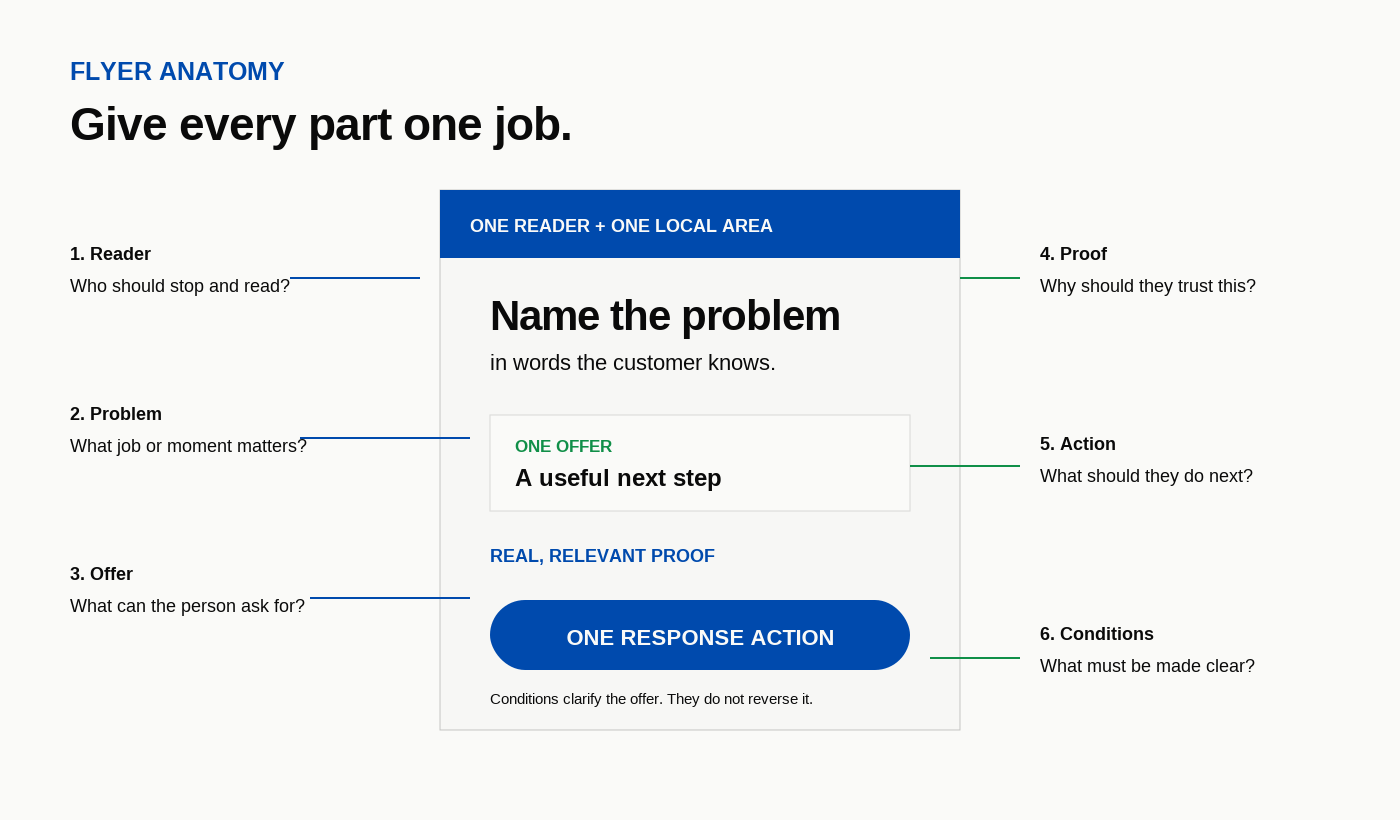
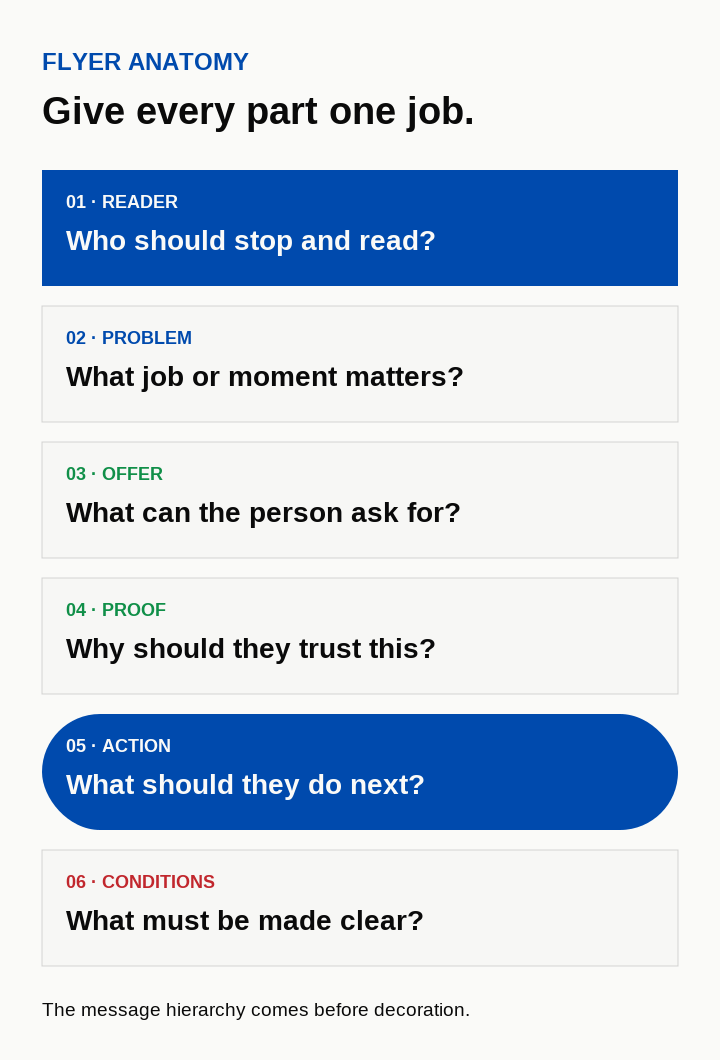
5. Create the flyer. Make the intended reader, problem, offer, proof and action easy to find. Decide the tracked response path before the artwork is approved.
6. Plan compliant delivery. Respect no-advertising signs, use suitable receptacles and plan for access and litter control. The Distribution Standards Board Code of Practice gives the Australian industry standard for responsible distribution.
7. Separate the response source. Use an agreed campaign phone number, short URL, QR destination or offer code. This is attribution: connecting a response to the source that may have prompted it. The signal must match the action customers are likely to take.
8. Prepare the response. Give the person answering calls the promoted service, area, qualification questions and next step. Decide who follows up and where the outcome will be recorded.
9. Record the outcome. Keep delivery evidence, responses, useful enquiries, quotes and booked work as different records. Connect them only where your call tracking, CRM or job-management system supports the link.
How should you design the flyer?
The design should help a household make one small decision: read on, keep the piece, call, scan or visit. Start with that decision before choosing colours, photographs or paper stock.
Name one reader. Write for the household or decision-maker most likely to need the job. A message for every homeowner usually sounds like it was written for nobody in particular.
Name one problem or moment. Use words a customer would use. A pre-summer air-conditioning service is clearer than a list of heating and cooling capabilities. A switchboard safety check is clearer than a wall of electrical services.
Make one offer and show one action. Tell the reader what they can ask for and what happens next. Keep the phone number or URL easy to read. A QR code may support the action, but it should not be the only explanation or the only route.
Add proof that helps this decision. A real credential, a permitted review, a clear process fact or an accurately labelled example may reduce risk. Decorative badges and vague claims do not. The ACCC guidance on false or misleading claims says the overall impression matters and fine print cannot contradict the main message.
Lock the tracking before print. The campaign number, URL, QR destination, offer code and artwork version belong in the approved proof. Test them from a printed copy at actual size, not only on a large design screen.
Use a three-question clarity check: Is this for me? What is being offered? What do I do next? This is a design test, not a claim that every person gives a flyer three seconds of attention.
| Flyer area | Job it should do | Typical content |
|---|---|---|
| Front | Help the right person recognise the problem and next step | Reader or area, problem, offer, main action and brand |
| Back | Answer the questions needed to act | How it works, relevant proof, inclusions, boundary, conditions and repeated action |
| Tracking and production | Identify the response path and version | Campaign number or URL, QR destination, offer code, artwork code and final production notes |
Which flyer format should you use?
Choose the format by the job it must do. Use the smallest piece that carries the decision clearly. Then give the printer and distributor the finished dimensions, weight, stock, sides, folds and assembly. Supplier words such as flyer, leaflet and pamphlet can mean different things.
A compact DL or A5 sheet can suit one local service or seasonal offer. A larger or folded piece can help when the reader needs a method, proof and conditions before acting. A multi-page piece may suit a real menu or detailed range. A magnet or sturdy keep-piece can suit a need that may happen later, as long as the contact path remains valid.
The extra space has to earn its cost. If the offer can be understood on one clear sheet, a complex pack may add weight and assembly without improving the decision. For production definitions and briefing details, use Gibson's flyer, pamphlet, catalogue and leaflet guide.
| Campaign job | Format to consider | Check before print |
|---|---|---|
| One local service or seasonal offer | Single-sheet DL or A5 | Readable type, room for conditions and final tracked response path |
| A service needing more explanation | Larger two-sided sheet or folded piece | Panel order, fold direction, finished size and handling |
| Several products, a menu or detailed range | Folded or multi-page piece | Weight, page count, production cost and whether each page earns its place |
| A delayed or emergency need | Useful magnet or sturdy card | Useful content, assembly, valid claims and a contact path that can stay current |
| A short reminder in one area | Postcard-style card or compact flyer | Version, timing, area and what this wave adds |
Should you send one flyer or a multi-piece pack?
Package the message first. The promoted job, offer, proof, response action and follow-up should feel like one system. A polished flyer that sends people to a different offer, or to a team that does not know the campaign, is a broken package.
A single-piece package works when the decision is simple. One flyer carries the problem, offer, proof and action.
A flyer plus a keep-piece can work when the main sheet explains why the service matters now and a magnet or card carries useful information for later. Both pieces need a clear role. Do not make the reader solve a puzzle to understand which number to use.
A multi-piece information pack can work when the buying decision truly needs deeper detail. Let one piece lead with the problem and action. Use the others for proof, service detail or product choices. Before approval, confirm whether the pieces are loose, attached, folded or enclosed, plus the final size, weight and thickness. The printer and distributor need to accept the finished construction.
A sequence of drops is another option. One wave might introduce the problem and offer. A later wave might add a use case or useful reminder. This is not a rule that every campaign needs three drops. Each wave needs a reason, a version record and a fair way to compare what changed.
- Give each piece one clear role.
- Check the finished pack, not just the separate artwork files.
- Make sure the pack enters and stays in a suitable receptacle.
- Use a consistent response path or record the path for each version.
- Choose a sequence when it teaches more clearly than one crowded bundle.
What could this look like for a local service business?
These are campaign use cases, not reported customer results. They show how the planning and measurement method could work without inventing response rates or revenue.
Inner West plumbing use case. The business promotes one plumbing job in the part of the Inner West it can serve quickly. The flyer uses a campaign phone number while Google keeps its own source number. The call handler records the suburb and plumbing problem. The business then checks ServiceTitan to see whether each suitable call became a booked job.
St George electrical use case. The flyer promotes one switchboard service and uses its own response number. The team checks the address, job type and urgency on the call. Simpro holds the later quote and completed-job status. A call count shows response. The Simpro link shows what happened after the response.
Eastern Suburbs air-conditioning use case. A pre-summer service message goes to selected homes in the operating area. The campaign has its own number or short URL. The team records the area and service wanted, then checks ServiceM8 for the quote and booking outcome.
The same rule applies to each example. The system name does not create the measurement. The source record, qualification fields and job outcome must be connected. If the connection stops at the call, report a call. Do not report a booked job.
“Call tracking tells you which path rang. The job system tells you what the business did with the call.”
How do you measure a letterbox campaign without fooling yourself?
Build the review before delivery begins. Decide which records will exist, who owns them and what each record proves. Call attribution is available only when campaign call tracking is included in the agreed scope.
Delivery tracking and call tracking answer different questions. Most distributor pages reviewed for this guide focus on GPS routes, delivery reports or spot checks. Some national campaign platforms also advertise tracked phone numbers or advise advertisers to arrange them. Compare who supplies and manages the number, what the report shows and whether the response can be followed into a business outcome.
Gibson's edge is providing the letterbox campaign and the managed call-tracking service together. Gibson sets up a separate campaign number, assigns it to the agreed artwork or area and reports the calls. The call can then be qualified by service and location, and connected to a CRM or job-management record where the approved setup supports that link. The business can review useful enquiries, quotes and booked work instead of stopping at a route map or raw call count.
Across the Inner West, St George and Eastern Suburbs, Gibson uses a regional supervisor, spot checks in selected areas and inspection photos on request. A GPS line shows where a device travelled. A person on the road can also inspect how material is being placed, check locations the distributor did not choose and record access or delivery problems. The checks are sampled evidence, so Gibson does not claim that they prove every letterbox received or read the flyer.
For response, count the agreed source signals: calls to the campaign number, visits to the short URL, QR scans or offer-code use. Then qualify the response. Was the customer in the service area? Did they want the promoted work? Was the timing useful? Finally, check the quote, booked job or recorded revenue only where the records support that link.
For a deeper setup, read how to track ROI on a letterbox drop. The essential point is simple: delivery evidence, a response and a booked outcome are three different facts.
| Evidence layer | Question | Example evidence |
|---|---|---|
| Delivery | Did the planned activity occur? | Start and finish updates, supervisor spot checks, inspection photos where requested and in scope |
| Response | Did people use a campaign path? | Calls to the agreed number, campaign URL visits, QR scans or offer-code use |
| Enquiry quality | Was the response useful? | Service wanted, area, timing and suitability |
| Commercial outcome | What happened next? | Quote, booked job, completed job or recorded revenue where available |
| Learning | What should remain or change? | Area, offer, artwork, timing, response process or capacity |
How does letterbox marketing compare with digital advertising?
Choose channels by the job they do. Search can capture a person already looking for a service. Social can reach or remind an audience selected through platform signals. Letterbox material can place a physical message in selected homes, including homes where nobody is searching today.
The channels can work together. A person may see the flyer, search the business name and call the website number. That journey is useful even when the flyer does not receive full credit. A campaign-specific phone number or URL gives you a clearer observed signal, but honest reporting still separates what was observed from what was inferred.
Keep the core promise aligned across the flyer, website and call handler. A household should not meet three different offers while moving through one campaign.
| Dimension | Letterbox | Search advertising | Social advertising |
|---|---|---|---|
| Starting signal | Selected homes or rounds | An active search | Audience and platform signals |
| Physical presence | Material enters the home environment | None | None |
| Immediate intent | May be low or latent | Often higher for a specific query | Varies by audience and creative |
| Measurement | Needs planned response paths and outcome records | Platform and website signals, with offline gaps | Platform and website signals, with offline gaps |
| Useful fit | Local awareness, seasonal service and selected areas | Capturing existing demand | Reaching or reminding selected audiences |
| Main risk | Weak targeting, offer, delivery or response handling | Expensive or irrelevant clicks | Attention without useful action |
How do you decide whether to run the next wave?
Put the evidence in order. First confirm what distribution activity was recorded. Then count the campaign responses. Check which responses were suitable. Follow the connected records into quotes and booked work. Only then decide what the campaign taught you.
Keep a part when the evidence says it helped or when you still need a stable control. Change a part when you can name the problem it may solve. If the area produced useful enquiries but few calls were answered, fix call handling before redesigning the flyer. If calls came from outside the service area, review the rounds and the wording. If people scanned but did not enquire, review the page and offer behind the QR code.
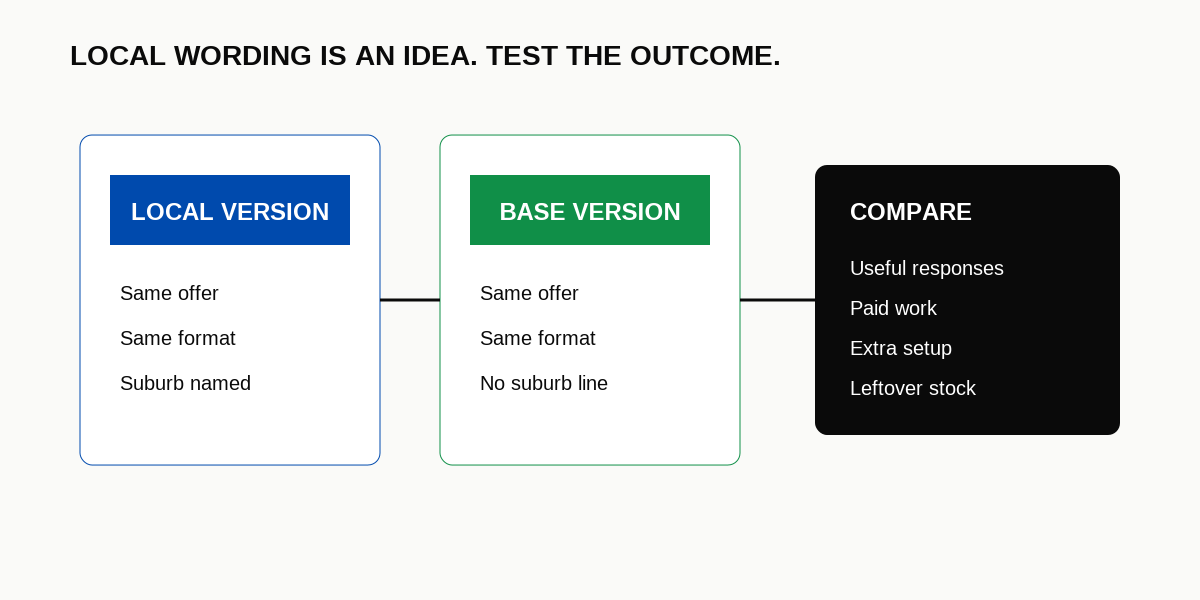
Avoid changing the area, offer, format, artwork, timing and phone process at once. You may get a different result, but you will not know why. A controlled test does not need a laboratory. It needs a clear question and one meaningful change. Gibson's suburb artwork test guide shows how to frame that question.
If a completed drop was quiet, use the post-campaign diagnostic guide before writing off the whole channel. If you are still planning, Gibson's Sydney letterbox service explains the delivery process, controls and areas currently served.
Where does Gibson fit?
Gibson helps businesses plan and distribute letterbox campaigns across its current Sydney service areas, including the Inner West, St George and Eastern Suburbs. The work begins with the area, quantity, format and delivery conditions. Where campaign call tracking is included, the response path can also be separated from other marketing calls.
A useful brief includes the service you want to promote, the areas you can serve, the action you want a household to take, the finished item or production plan and the evidence you need after the drop. That gives the campaign a business job before it becomes a print order.
Start with the full letterbox distribution service guide. When the area and material are ready for scoping, use the letterbox quote form.
Frequently asked questions
Do letterbox flyers still work in Australia?
They can create useful local demand when the area, job, offer, delivery and response process fit. Judge the campaign through separate delivery, response, enquiry-quality and booked-outcome records. Do not rely on a universal response rate.
How many flyers should a local business distribute?
Start with the homes you can serve well, the accepted delivery rounds, your budget and your ability to handle the response. Choose the quantity after those decisions. A larger number is not automatically a better campaign.
How many times should the same area receive a flyer?
There is no universal frequency. Give each wave a clear role, record its version and review what happened before repeating it. Keep useful parts stable and change one meaningful variable when the goal is learning.
Which flyer size and format should I use?
Use the smallest format that carries the decision clearly. A DL or A5 sheet may suit one service. A folded or larger piece may suit a decision that needs more explanation. Confirm finished size, weight, stock, folds and assembly with the printer and distributor.
Should I send one flyer or a multi-piece pack?
Use one flyer when the decision is simple. Add a keep-piece or supporting sheet only when it has a clear job. Confirm the final pack's dimensions, weight, assembly and delivery acceptance before print.
Does GPS tracking prove flyers were delivered?
Route or location records can support a delivery review, but they do not prove that every letterbox received the material or that anyone read or acted on it. Keep delivery evidence separate from response and sales outcomes.
Can a QR code measure a flyer campaign?
A QR scan measures one response action. It does not automatically show whether the person called, qualified, received a quote or booked. Connect the destination and later business records if you need those answers.
How can I tell which flyer calls became jobs?
Give the flyer an agreed campaign number, capture the service and area on the call, then connect the call record to the CRM or job-management outcome. This is possible only when the approved tracking and system setup supports the connection.
Can flyers and Google Ads run together?
Yes. They can serve different moments in the same customer journey. Keep the offer consistent and use separate source signals where practical. Report observed responses separately from journeys you can only infer.
Can material be delivered to every letterbox in a suburb?
No-advertising signs, access, postal-round boundaries and suitable receptacles affect the reachable count. Plan from accepted deliverable rounds and record exclusions instead of promising every address.
Sources and evidence
- Australia Post Campaign Targeter: Geographic and demographic campaign planning. It is not evidence of response.
- Australia Post Letterbox Advertising Guide: Postal-round planning, preparation and no-advertising-material guidance.
- Distribution Standards Board Code of Practice 2025: Australian industry guidance for responsible distribution.
- ACCC: False or misleading claims: Guidance on accurate claims and the overall impression of advertising.
- JICMAIL Q2 2026 results: UK household-panel evidence only. The figures are directional context, not an Australian or Gibson result.
- JICMAIL methodology: Kantar-managed UK household panel and 28-day diary method.