What you need to know
- Use the time an enquiry was received, not the time it was entered into a report.
- Compare calls, forms and messages separately before combining them.
- A missed call or slow reply needs investigation; it is not automatically a lost job.
- Check whether a useful callback happened before changing staffing or advertising.
What is an enquiry coverage gap?
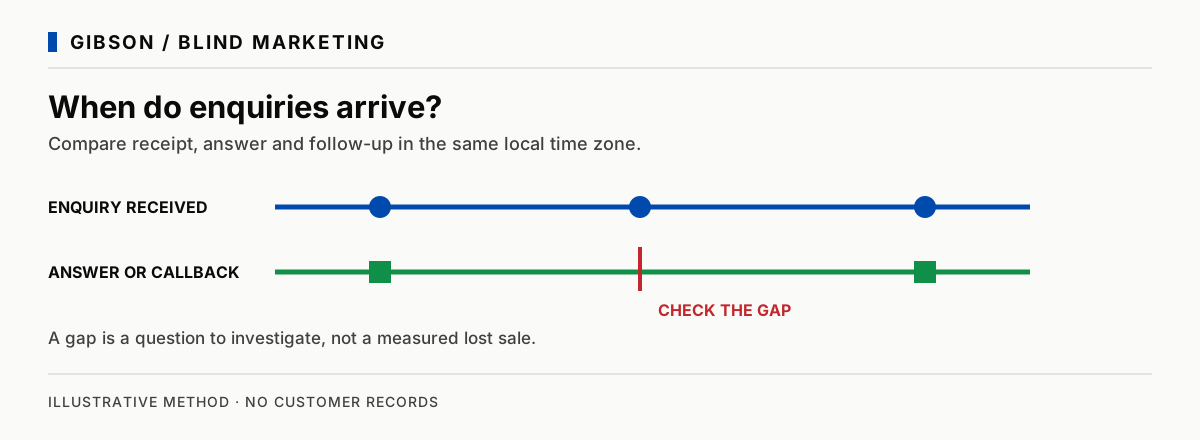
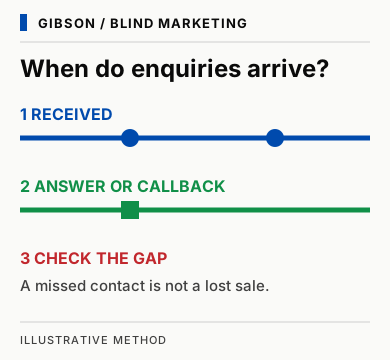
An enquiry coverage gap is a repeated period when genuine customer contacts arrive but no one is available to answer or follow up in the way the business has chosen. It is a scheduling and process question, not a count of sales lost. A caller may try again, leave a message, use a form or buy elsewhere. The record alone does not tell you which happened.
Begin with a small sample of recent working days. Keep the original received timestamp, the channel and the local time zone. If the reporting system stores UTC, convert it before comparing contacts with roster hours. Note public holidays and exceptional closure days rather than treating them as normal weekdays.
Which timestamps should you compare?
For each phone enquiry, record when the call arrived, whether it connected, and whether a callback was attempted and completed. For a form or email, record submission time and the first response that addressed the customer's question. An automatic receipt only confirms delivery; it does not show that someone understood the request.
Google Ads call reporting can show start time and whether a reported call was missed or received. It also distinguishes calls from call conversions, which may depend on a chosen duration. That makes the exact report column and source system important when comparing numbers. Your own phone system and inbox may show different parts of the journey.
| Record | Keep | Ask |
|---|---|---|
| Call | Arrival time, answer state, callback state | Did someone reach the caller or resolve the question later? |
| Form | Submission time, first useful reply | Did a person answer the actual request? |
| Email or message | Received time, first useful reply | Was the reply relevant, and who owned the next step? |
| Unknown | Missing time or channel reason | What can be checked before assigning an outcome? |
How do you find a repeated gap without overreacting?
Group contacts into the same local-hour windows and compare similar days. Look at genuine contacts, not just clicks on a phone number. Check whether two records belong to the same person and job before counting them as separate demand. A single unusual afternoon is a prompt to inspect the records, not a reason to change a roster.
Then compare arrival with actual coverage. A team can be open while the person who handles a specialist enquiry is unavailable. A call can be answered but transferred without resolution. A callback can close the gap later. Record the useful outcome, the remaining question and who owns it.
- Choose one comparable period and confirm the time zone in every source.
- Separate genuine calls from number clicks and call-conversion counts.
- Mark answered, missed, callback completed and still unknown distinctly.
- Look for a pattern across comparable days before changing cover.
What should change after you find a gap?
Agree one action that fits the cause. It might be a clearer callback owner, a routing change, a form notification, or cover for a recurring busy window. Set a way to check whether genuine enquiries received a useful response after the change. Do not promise that every contact will become a sale.
Gibson can connect available advertising, call, form and sales records, identify what cannot be followed and agree an action plan with your business. If the records cannot support an hour-by-hour comparison, the first action is to improve the timestamp and ownership trail.
Frequently asked questions
Is every missed call a lost customer?
No. A caller may reach the business later, leave a message, use another channel or decide not to proceed. Check callbacks and the later customer record before assigning an outcome.
Should an automatic confirmation count as a response?
It counts as a delivery acknowledgement. For this check, use the first reply that addresses the customer's actual question as the useful response.
Can I compare Google Ads call conversions with my phone log?
Only after confirming the metric, date basis, duration threshold and number coverage. Google distinguishes phone calls from call conversions, so the totals can differ for valid reasons.
Sources and evidence
- Google Ads: analyse call reporting data: Defines call details, missed or received status, and the difference between phone calls and call conversions.