What you need to know
- Start and stop each clock at named events.
- A receipt email is not the first useful answer to a customer's question.
- An open quote has a current age, not a completed time to sale.
- Agree the next action from the actual reason for waiting.
Which waiting time are you measuring?
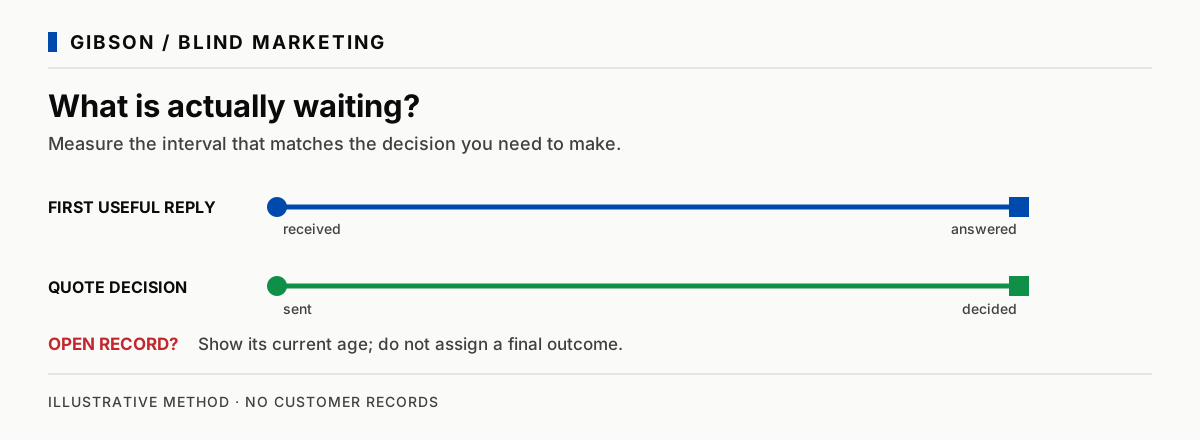
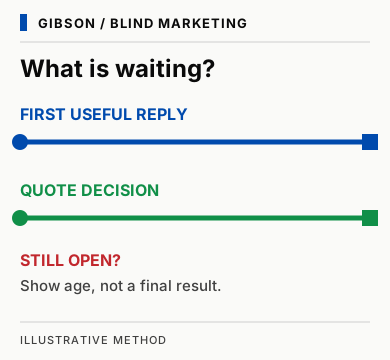
Enquiry waiting time can mean several things. Time to first useful reply starts when the customer contacts the business and ends when someone answers the actual request. Lead age starts at first contact and continues while the record remains open. Quote age starts when a particular version was sent. Time to paid work runs from the original enquiry to a confirmed payment for completed work.
Each clock answers a different question. Choose the one tied to the decision you need to make and record its start and stop event. If a person called before submitting a form, the earliest genuine contact may be the correct start for the customer journey. Keep both interactions in the record.
| Measure | Start and end | Use it to ask |
|---|---|---|
| First useful reply | Enquiry received to relevant human reply | Did the customer get an answer? |
| Open enquiry age | First contact to the review date | Who owns the next step now? |
| Quote age | Current quote version sent to decision or review date | What is the quote waiting for? |
| Time to paid work | First contact to confirmed payment | How long did completed work take? |
Why should open and completed records be separate?
An open enquiry has not yet reached a final outcome. It can still become work, be declined or remain unresolved. Mixing it into a completed average makes a recent source look worse simply because its customers have had less time to decide. Google Ads likewise warns that conversion delay can leave recent reporting periods incomplete. Its reporting rule does not define your own sales cycle, but it illustrates why cohort age matters.
Compare enquiries that began in the same period and show how many remain open. For completed records, use the observed decision date. For open records, display age as of the review date with the status and owner. Do not silently assign a sale date or loss reason.
What is a quote actually waiting for?
A quiet quote can have several explanations: the customer needs a scope answer, an internal approval is pending, the work is no longer required, or the business has not followed up on an agreed step. The age alone cannot distinguish them. Read the last conversation and the current quote version before sending another reminder.
If the customer asks for a revision, record the reason and the new version. If a decision has been made, close the open status. If the next move belongs to the business, give it an owner. Good follow-up helps the customer decide; it is not a campaign of repeated pressure.
- Read the most recent customer exchange and quote version.
- Mark whether the next action belongs to the customer or your team.
- Record a clear decision when the work is accepted or declined.
- Keep the still-open group separate when reporting source results.
How do you turn the timing check into an action?
Choose one gap that the records support. A slow first answer might call for clearer notifications or a backup owner. A quote waiting for scope needs clarification. A long time to paid work may be normal for the type of job. Check with the people doing the work before changing the process.
Gibson can connect the available advertising, enquiry and sales records, show where the timing trail breaks and agree an action plan with your business. If the timestamps or quote states are missing, the first action is to make those records dependable.
Frequently asked questions
Does an old quote mean the customer is no longer interested?
No. Age alone does not explain the customer's decision. Read the latest exchange and check whether scope, approval, timing or a clear decline is recorded.
Should I count an automatic email as the first reply?
Count it as a receipt acknowledgement. For time to first useful reply, use the first response that addresses the request.
Can I average open and completed enquiries together?
Not for a final time-to-sale measure. Show open records with their current age and completed records with their observed outcome dates.
Sources and evidence
- Google Ads: conversion delay: Explains why recent reporting periods can be incomplete while later outcomes are still arriving.