What you need to know
- An Australian recruitment agency replaced a third-party offshore CV-formatting provider with a local staff-operated tool.
- The client reports about A$2,000 in annual direct supplier savings and a typical five-minute processing time for a supported CV.
- The former provider's 79% accuracy baseline was supplier reported and was not independently calculated by Gibson.
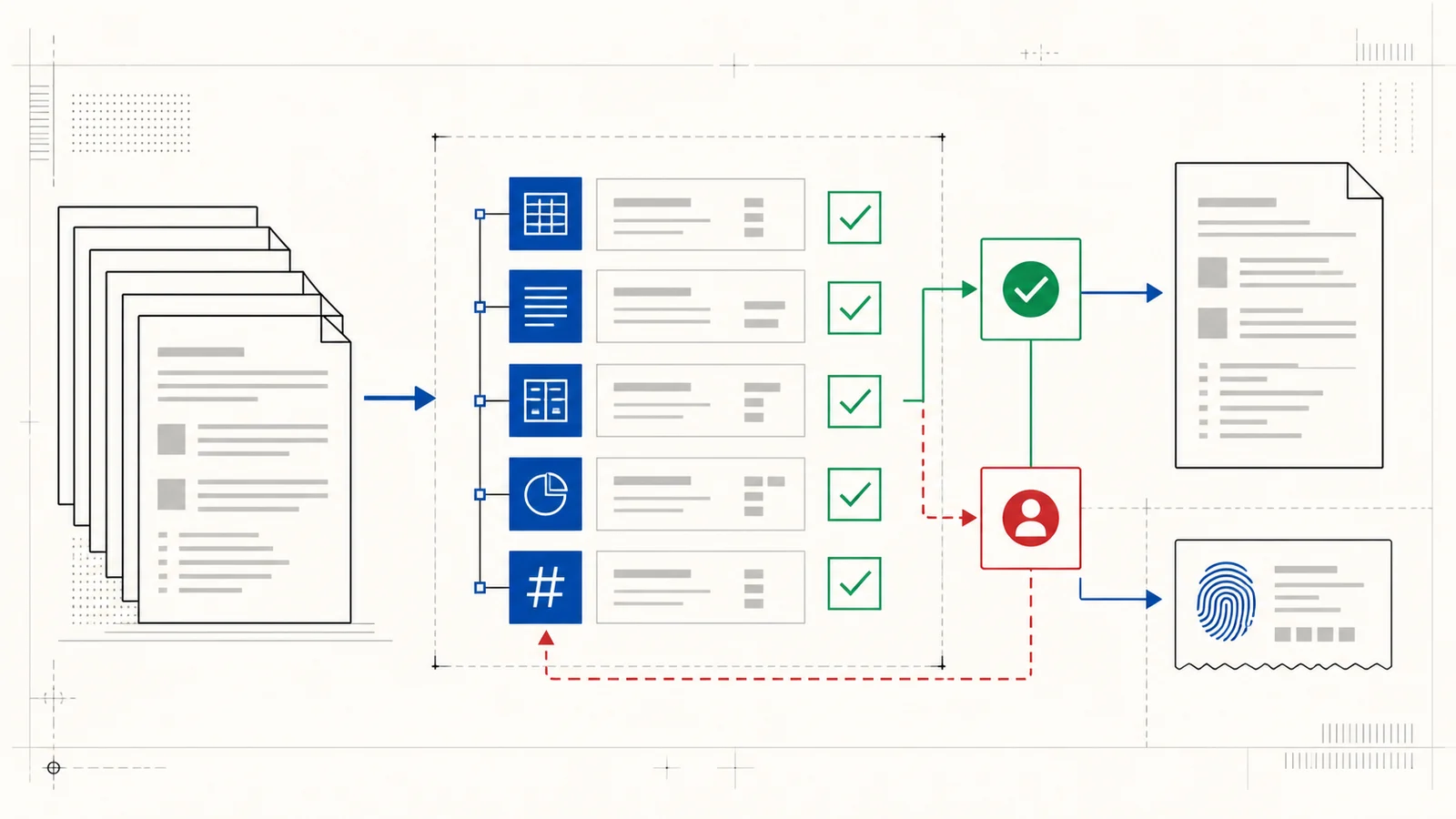
- Deterministic code performs the transformation, then reopens and reconciles the output against the source before delivery.
- Candidate data remains inside the client's controlled local environment during routine formatting.
- Scanned, ambiguous and failed files stop for human review instead of producing a confident guess.
Can AI reformat a CV without rewriting it?
Yes. AI can reformat a CV without rewriting it when the language model is limited to understanding the request and deterministic code performs the transformation. The source remains authoritative, the generated file is reopened and reconciled, and a result that does not pass is withheld for review.
The client used this pattern to replace an offshore provider with a local staff-operated tool. A redesigned layout is one thing. A silently changed job title, date, qualification or duty is a different candidate record.
“The AI can ask for the job. It cannot redefine what a passing job means.”
What business problem did an Australian recruitment agency remove?
The client is an Australian recruitment agency that reformats candidate CVs into its private house style before presenting them to employers.
The business had been sending candidate CVs to a third-party offshore provider. The client reports that retiring that dependency removed about A$2,000 in annual direct supplier cost. The former supplier's reported accuracy baseline was 79%, so returned files still required internal checking.
The replacement runs locally on approved staff laptops. Authorised staff can start the process when it is needed, typically completing a supported CV in about five minutes. Routine formatting no longer requires the candidate file to be sent to Gibson or the former offshore provider.
The client confirmed these operating baselines on 6 August 2026. The figures are specific to this unnamed client and are not universal savings, processing-time or accuracy forecasts.
| Measure | Client result | Evidence boundary |
|---|---|---|
| Annual direct supplier cost removed | About A$2,000 | Client reported |
| Typical supported CV processing time | About five minutes | Supported files only |
| Former supplier accuracy baseline | 79% | Supplier reported, not a Gibson measurement |
| Routine processing location | Approved staff laptops | Inside the client's controlled environment |
| Reviewed release checks | 49 tests passed | Unit and workflow release evidence |
What changed for staff day to day?
CV formatting became work an authorised employee could start when the candidate file was ready. Staff no longer needed to send each routine job to an offshore queue, wait for its return and then begin a separate correction cycle.
The tool does not remove professional responsibility. It moves routine transformation and checking into a repeatable process while keeping uncertain files visible to a human.
- Start a supported job locally when the CV is ready.
- Receive either a passed document with an evidence receipt or a clear review action.
- Keep control of the source file, private house format, staff access and exception decision.
- Reuse a validated result instead of creating uncontrolled duplicate outputs.
Why is a normal AI prompt the wrong control for this job?
Generative AI is designed to generate. Ask a general chat tool to make a CV cleaner and it may shorten a paragraph, standardise a date, combine bullets or improve wording. Those behaviours can help when a candidate has authorised editing. They are not acceptable when a recruiter is only authorised to apply an agency format.
An instruction such as 'do not change a word' is useful guidance, but it is not independent verification. The same model is interpreting the source, performing the transformation and judging its own output.
The controlled alternative separates the roles: AI understands the request, deterministic code performs the extraction and rendering, a separate reconciliation process checks the reopened output, and the delivery gate releases only a result that passes.
What is deterministic CV formatting?
Deterministic CV formatting is a document workflow in which the allowed transformations are defined before the job runs. The source file remains authoritative. Every source block must be included, changed under an approved presentation rule, excluded under an approved rule or stopped for review. The finished document is reopened and checked before it can reach the output folder.
In this use case, approved rules control how source content moves into the client's private house format. Free-form rewriting is not an approved transformation. The template, its layout rules and candidate documents remain private.
A supported CV is a DOCX or machine-readable PDF that passes source extraction, template-fingerprint, reconciliation and structural checks. Scanned, legacy, ambiguous or failed files stop for explicit review.
How does the controlled workflow operate?
The workflow creates evidence before it creates a deliverable. Each stage narrows what the system is allowed to claim about the result.
- Keep the original untouched and hash the local source file.
- Extract ordered readable blocks into an immutable source ledger.
- Apply only approved mapping and presentation rules.
- Save the DOCX, reopen it and inspect the actual output package.
- Reconcile included content, approved exclusions and unexpected output.
- Run the private structural contract and placeholder checks.
- Deliver only after PASS. Failed reconciliation produces a review action, not a final CV.
What did the synthetic proof run establish?
The public-safe demonstration used an invented candidate and invented employers. It does not expose a real CV, the client's template or confidential layout rules.
The output package reopened, the private-layout fingerprint check passed and no unfilled placeholders were recorded. The release also passed 49 unit and workflow tests covering punctuation mutation, word reordering, missing structural markers, unapproved transformations, persisted job state and duplicate prevention.
The receipt accounts for what came in, what was included, what was deliberately excluded, what came out and whether anything was missing or unexpected. These figures establish the defined synthetic run, not every possible CV format.
| Evidence item | Recorded result |
|---|---|
| Source blocks | 34 |
| Included blocks | 32 |
| Approved exclusions | 2 |
| Output items | 35 |
| Unaccounted source blocks | 0 |
| Unexpected output items | 0 |
| Validation checks | 7 of 7 passed |
| Structural checks | 21 of 21 passed |
What does verified mean here?
For a delivered file, verified means the formatter accounted for the source under the approved inclusion, transformation and exclusion rules, detected no unexpected output items and passed the defined structural checks. It does not certify the truth of the candidate's statements or eliminate human responsibility.
- It does not mean every scanned image was interpreted perfectly.
- It does not mean every possible CV layout is supported.
- It does not make privacy compliance automatic.
- It does not authorise the system to improve the candidate's writing.
- It does not remove the human review path.
What happens when the system cannot prove the result?
Refusal is part of the product. The workflow makes uncertainty visible while an authorised person can still decide what happens next.
- An ambiguous filename produces a choice, not a guess.
- An incomplete setup stops before a document is generated.
- OCR or legacy conversion requires visual confirmation.
- A changed master-template fingerprint blocks the run.
- An unaccounted source block or unexpected output item blocks delivery.
Does local processing solve CV privacy obligations?
No. Local processing removes the routine offshore transfer from this workflow, but it does not make a recruitment business automatically compliant.
The Office of the Australian Information Commissioner says privacy obligations apply to personal information used with AI. Its guidance recommends due diligence, consideration of who can access the information, appropriate human oversight and caution before entering personal information into publicly available generative-AI tools.
A real implementation still needs an assessment of Privacy Act coverage, notices, permitted use, access controls, retention, staff permissions, security and incident response. Legal advice may be required for the operating context.
How does deterministic formatting compare with the alternatives?
Editing, human-led formatting and deterministic transformation are different jobs. The correct method depends on what the business is authorised to change and what evidence must exist before delivery.
| Approach | Useful when | Main control gap |
|---|---|---|
| General AI chat | An authorised person wants help rewriting or tailoring content | A prompt alone does not independently prove that wording stayed unchanged |
| Manual or outsourced formatting | Volume is low or human editorial judgement is required | Cost, turnaround, external handling and checking remain operating dependencies |
| Deterministic formatter | Presentation may change but source wording must stay governed | Requires a frozen template, supported inputs, explicit rules and maintained tests |
When is deterministic document formatting a good fit?
It is a good fit when source wording must remain authoritative, presentation rules repeat across many documents and the business can define a clear pass, stop and human-review decision. It is a poor fit when the actual job is creative writing or subjective editorial judgement.
The same architecture can support other repeatable document work where presentation may change but the source must remain traceable, including policy migrations, compliance packs, regulated correspondence and tender submissions. Every use case still needs its own source rules, exclusions, review gates and acceptance tests.
- Use it when changing source meaning would create material risk.
- Use it when approved transformations and exclusions can be written down.
- Do not force it when most sources require interpretation from poor scans.
- Do not force it when no one can define the evidence required before delivery.
What must a business decide before implementing it?
Start with an operating contract, not a software brand. Name the source of truth, allowed changes, exceptions, evidence and accountable person before adding an AI interface.
- Is the job formatting, editing, summarising or decision-making?
- Which source content must remain authoritative?
- Which transformations and exclusions are explicitly approved?
- Which inputs require OCR or human review?
- What evidence must exist before delivery?
- Where will source files, temporary work and receipts be stored?
- Who owns the template, exceptions and future rule changes?
- How will the packaged product be tested through the same interface employees use?
“If the business cannot name the source, allowed change, review owner and delivery evidence, a chat interface will not create a controlled workflow.”
Frequently asked questions
Can ChatGPT or Claude reformat a CV without changing the content?
They can be instructed to preserve content, but an instruction is not independent proof. For high-fidelity work, use the model to understand the request and invoke a deterministic formatter that reconciles the reopened output against the source before delivery.
What is the difference between CV formatting and CV rewriting?
Formatting changes presentation, such as the template, typography, headings, spacing and approved structural placement. Rewriting changes language or meaning. A controlled workflow states which transformations are permitted instead of treating both jobs as one AI task.
How can a system prove that candidate wording was preserved?
It can fingerprint the source, create an ordered source ledger, record approved mappings and exclusions, reopen the output and compare its content with the ledger. Delivery is blocked when unaccounted source blocks or unexpected output exceed the approved rule.
Can scanned CVs be reformatted automatically?
They can pass through OCR, but OCR introduces a separate interpretation risk. In this use case, scanned or legacy content stops for visual human confirmation before the controlled formatting workflow continues.
What does the 79% baseline mean?
It is the former supplier's reported accuracy baseline, confirmed by the client for this case study. It is not an accuracy test conducted by Gibson. The replacement uses a different rule: reconcile supported output against the source or stop for review.
Can I download the client's CV template?
No. The company template, candidate documents and detailed layout rules remain private. The public proof explains the control method and publishes non-sensitive reconciliation totals, not the underlying template or candidate data.
Does local AI processing guarantee Australian privacy compliance?
No. It can reduce or remove a particular data-transfer path, but the business must still assess collection, use, disclosure, access, retention, security, transparency and other legal obligations for the actual implementation.
Is this controlled-document pattern limited to CVs?
No. The same pattern can suit repeatable document work where presentation may change but source wording must remain traceable. Each use case still needs its own rules, evidence and review gates.
Sources and evidence
- Office of the Australian Information Commissioner: privacy and commercially available AI products: Australian guidance on due diligence, access to personal information, human oversight and public AI tools, updated 17 January 2025.