What you need to know
- Define suitable work before comparing channels.
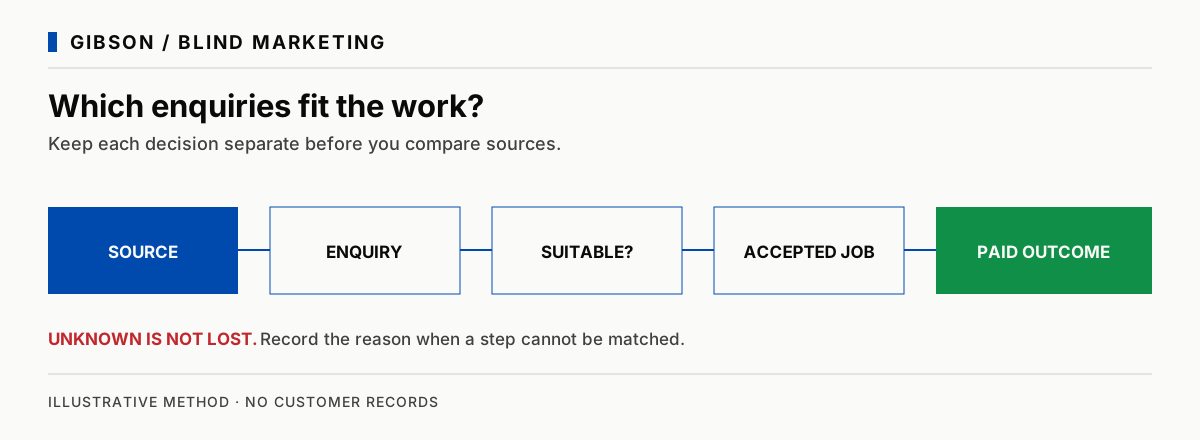
- Keep an enquiry, a sales opportunity, an accepted job and a paid outcome separate.
- Match records only where the identifiers and dates support the link.
- Show unknown or still-open outcomes instead of treating them as losses.
What is a suitable enquiry?
A suitable enquiry asks for work the business can and wants to deliver under the conditions it has chosen. The definition might include service type, location, capacity, timing and the decision maker's need. It should be agreed with the people who quote and deliver the work, not guessed from a marketing dashboard.
Suitability is not a promise of a sale. Someone can be a good fit and still choose another provider. Someone can be outside the current criteria and still receive a courteous answer. Write the criteria before looking at the source totals so a preferred channel does not quietly change the definition.
Which records show the journey to paid work?
Start with the source and the first genuine enquiry. Connect it to the customer record, then to a quote or opportunity, an accepted job and a confirmed paid outcome where those records exist. These are different stages. A form submission is not an accepted job, and a quote value is not paid revenue.
Zoho CRM's lead conversion can create a contact, account and, when appropriate, a deal. That describes a possible CRM path, not proof that a deal was won or paid. Check your actual field mapping and job or payment system before making a source-to-revenue claim.
| Stage | Evidence to look for | Do not assume |
|---|---|---|
| Genuine enquiry | Call, form or message with a customer need | That the person is suitable |
| Suitable enquiry | Agreed criteria recorded by the team | That the customer will buy |
| Accepted job | Decision or job record with a clear owner | That payment has been received |
| Paid outcome | Reconciled payment or accounting record | That the source is profitable without delivery costs |
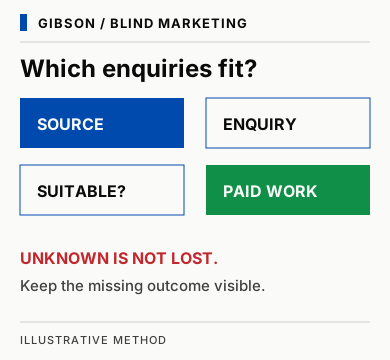
| Unknown | Missing match or open decision | That the enquiry failed |
How can you compare sources fairly?
Use a comparable cohort: enquiries received in the same period, with enough time for a typical decision. Record the marketing source only where it is observable. A person might call and submit a form about one job; deduplicate with care rather than counting two opportunities. Keep direct and unknown sources visible.
For each source, show genuine enquiries, suitable enquiries, accepted jobs, paid jobs and records still open or unmatched. If spend is known, cost per suitable enquiry can be useful. Cost per paid job needs a reliable job match and payment state. Profitability also needs the cost of delivering the work. A cheap lead total alone cannot answer which source is best for the business.
- Agree the suitability rule with sales and delivery before reviewing sources.
- Choose one cohort and allow comparable follow-up time.
- Inspect duplicate contacts and missing source fields.
- Show open and unknown outcomes in the comparison, not in the lost column.
What should your marketing team receive?
Share the service types and customer needs that became suitable work, along with the number of records whose outcome is still unknown. Explain why a source appears weak: poor fit, slow response, missing record links or a real lack of accepted work are different problems. Avoid sending customer personal data unless your arrangements and permissions support it.
Gibson helps connect available advertising, enquiry and sales records, identify the gaps and agree an action plan. Your marketing team remains responsible for the ads and budgets. The first useful result may be a better definition or a missing-record fix, rather than a channel ranking.
Frequently asked questions
Is a lead the same as a customer?
No. A lead or enquiry is an initial contact. Qualification, a job decision and payment are separate stages that need their own evidence.
Can I call a source profitable from cost per lead?
No. Cost per lead omits whether the work was suitable, accepted, paid and economical to deliver. Use the measures that your records can actually support.
What if a customer calls and also sends a form?
Check whether both contacts concern the same person and job. Keep the interactions, but avoid counting two separate sales opportunities when there was only one.
What should I do with unknown sources?
Keep them visible and investigate the tracking or record handoff. Do not assign them to a preferred channel without evidence.
Sources and evidence
- Zoho CRM: converting leads: Explains that lead conversion may create account, contact and deal records, subject to the actual CRM setup.
- Google Ads: conversion delay: Explains why recent cohorts can appear incomplete while later outcomes are still arriving.